Instructions:
- The marks are indicated in the right-hand margin.
- There are NINE questions in this paper.
- Attempt FIVE questions in all.
- Question No. 1 is compulsory.
- Symbols used (if any) have their usual meanings.
Q.1 Choose the correct option of the following (any seven):
The angular velocity of rotating body is expressed in terms of
Which of the following statements is wrong?
Which type of vibration is also known as transient vibrations?
Transmissibility is the ratio of
A non-inertial reference frame is a frame of reference that is undergoing ______ with respect to an inertial frame.
A turning car with constant speed is the example of
When a particle moves with a uniform velocity along a circular path, then the particle has
Gradient of scalar field is ______ to the equipotential surface.
Example of non-conservative force is
Pooja spins a ball of mass $ m $ attached to a string of length $ r $ around her head with a velocity $ v_i $. If the ball splits in half, losing exactly one-half of its mass instantaneously, what is its new velocity, $ v_f $?
Q.2 Solve both questions :
A particle moves in a circle of radius $ b $ with angular velocity $ \theta = \alpha t $, where $ \alpha $ (rad / sec²) is a constant. Describe the particle's velocity in polar coordinates.
Three freight cars of mass $ M $ are pulled with force $ F $ by a locomotive. Friction is negligible. Find the forces on each car.
Q.3 Write short notes on the following:
Q.4 Solve all parts :
Discuss three-dimensional rigid body motion describing angular velocity and moment of inertia tensor.
The position of a particle of mass $ m $ under the influence of a free particle is given by $ \vec{r} = A \sin( \omega t) \hat i + B \cos( \omega t) \hat j $. Find the expression for its force.
Express $ \vec{s} $ of cylindrical coordinate system into unit vectors of Cartesian coordinate system.
Q.5 Solve both questions :
Explain Euler's law of motion and derive an expression for the Euler's equation of motion for rigid body.
Prove that curl of a conservative force is equal to zero.
Q.6 Solve this question :
Write and solve equation of motion of a mass executing simple harmonic oscillation in the presence of a damping force. Also discuss the cases of over damping, critical damping and undamping oscillations.
Q.7 Solve both questions :
Show that if the total linear momentum of a system of particles is zero, the angular momentum of the system is the same around all origins.
A particle with a mass of $ 4kg $ has a position vector in metre given by $ r = 3t^2 \hat i - 2t \hat j - 3t \hat k $, where $ t $ is the time in seconds. For $ t = 3 $ seconds, determine the magnitude of the angular momentum of the particle and the magnitude of the moment of all forces on the particle, both about the origin of coordinates.
Q.8 Write short notes on the following:
Q.9 Write short notes on any two of the following:
Instructions:
- The marks are indicated in the right-hand margin.
- There are NINE questions in this paper.
- Attempt FIVE questions in all.
- Question No. 1 is compulsory.
- Symbols used (if any) have their usual meanings.
Q.1 Choose the correct option of the following (any seven):
The angular velocity of rotating body is expressed in terms of
Which of the following statements is wrong?
Which type of vibration is also known as transient vibrations?
Transmissibility is the ratio of
A non-inertial reference frame is a frame of reference that is undergoing ______ with respect to an inertial frame.
A turning car with constant speed is the example of
When a particle moves with a uniform velocity along a circular path, then the particle has
Gradient of scalar field is ______ to the equipotential surface.
Example of non-conservative force is
Pooja spins a ball of mass attached to a string of length around her head with a velocity . If the ball splits in half, losing exactly one-half of its mass instantaneously, what is its new velocity, ?
Q.2 Solve both questions :
A particle moves in a circle of radius with angular velocity $ \theta = \alpha t \alpha $ (rad / sec²) is a constant. Describe the particle's velocity in polar coordinates.
Three freight cars of mass are pulled with force by a locomotive. Friction is negligible. Find the forces on each car.
Q.3 Write short notes on the following:
Q.4 Solve all parts :
Discuss three-dimensional rigid body motion describing angular velocity and moment of inertia tensor.
The position of a particle of mass under the influence of a free particle is given by . Find the expression for its force.
Express of cylindrical coordinate system into unit vectors of Cartesian coordinate system.
Q.5 Solve both questions :
Explain Euler's law of motion and derive an expression for the Euler's equation of motion for rigid body.
Prove that curl of a conservative force is equal to zero.
Q.6 Solve this question :
Write and solve equation of motion of a mass executing simple harmonic oscillation in the presence of a damping force. Also discuss the cases of over damping, critical damping and undamping oscillations.
Q.7 Solve both questions :
Show that if the total linear momentum of a system of particles is zero, the angular momentum of the system is the same around all origins.
A particle with a mass of has a position vector in metre given by $ r = 3t^2 \hat i - 2t \hat j - 3t \hat k t t = 3 $ seconds, determine the magnitude of the angular momentum of the particle and the magnitude of the moment of all forces on the particle, both about the origin of coordinates.
Q.8 Write short notes on the following:
Q.9 Write short notes on any two of the following:
Instructions:
- The marks are indicated in the right-hand margin.
- There are NINE questions in this paper.
- Attempt FIVE questions in all.
- Question No. 1 is compulsory.
- Symbols used (if any) have their usual meanings.
Q.1 Answer any seven of the following questions :
The position of a particle of mass $ m $ under the influence of a free particle is given by $ \vec{r} = A \sin \omega t \hat{i} + B \cos \omega t \hat{j} $. Find the expression for its force.
Express $ \vec{s} $ of cylindrical coordinate system into unit vectors of Cartesian coordinate system.
Give two examples of conservative forces.
Define Euler angles.
Consider a cloud of point particles interacting through gravitational forces and having a distribution of kinetic energy. What is the condition of potential energy under which this cloud will expand?
Why is a Foucault pendulum situated at the equator will not detect the rotation of the earth about its axis?
A condenser of capacity $ 1 \, \mu F $, an inductance $ 0 \cdot 2 \, H $ and a resistance of $ 100 \, \Omega $ are in series. Is the circuit oscillator? Why?
A pendulum is of length 50 cm. Find its period when it is suspended in (i) a stationary lift and (ii) a lift falling at a constant velocity of 5 m/s.
Write down the expression for moment of inertia of a solid circular disk, axis perpendicular to its plane and passing through the centre.
Fill in the blank : Gradient of scalar field is ______ to the equipotential surfaces.
Q.2 Solve both questions :
A particle moves with $ \dot{\theta} = \omega = $ constant and $ r = r_0 e^{\beta t} $, where $ r_0 $ and $ \beta $ are constants. For what values of $ \beta $, the radial part of acceleration vanishes?
A point is observed to have velocity $ V_A $ relative to coordinate system $ A $. What is its velocity relative to coordinate system $ B $, which is displaced from system $ A $ by a distance $ R $? ($ R $ can change in time.)
Q.3 Solve both questions :
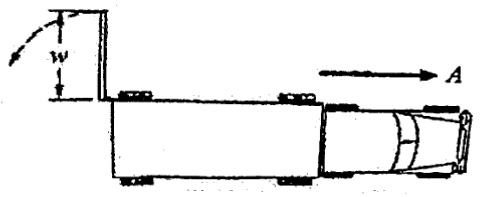
A truck at rest has one door fully open, as shown below. The truck accelerates forward at constant rate $ A $, and the door begins to swing shut. The door is uniform and solid, has total mass $ M $, height $ h $, and width $ w $. Neglect air resistance. Find the instantaneous angular velocity of the door about its hinges when it has swung through $ 90^{\circ} $.
Using cylindrical coordinate system, find out the volume of a cylinder of radius $ R $ and height $ H $.
Q.4 Solve this question :
What are conservative and non-conservative forces? Show that the electrostatic force between two charges $ q_1 $ and $ q_2 $ placed at a distance of $ r $ are conservative. Also, obtain an expression for the potential energy of two charges.
Q.5 Solve both questions :
State and discuss Kepler's law. Show that the Newton's law can be deduced from Kepler's law.
Discuss the energy equation in the centre of mass system.
Q.6 Solve both questions :
Derive Euler's equations of rigid body motion and discuss their necessity in describing rigid body.
Explain, why flying saucers make better spacecraft than do flying cigars.
Q.7 Solve both questions :
Discuss three-dimensional rigid body motion describing angular velocity and moment of inertia tensor.
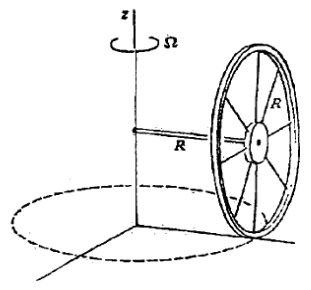
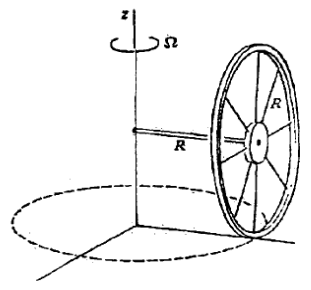
A thin hoop of mass $ M $ and radius $ R $ rolls without slipping about the z-axis. It is supported by an axle of length $ R $ through its centre. The hoop circles around the z-axis with angular speed $ \Omega $. What is the instantaneous angular velocity of the hoop? Given, the moment of inertia of a hoop for an axis along its diameter is $ \frac{1}{2} MR^2 $.
Q.8 Solve this question :
Discuss three-dimensional rigid body motion describing angular velocity and moment of inertia tensor.
A thin hoop of mass M and radius R rolls without slipping about the z-axis. It is supported by an axle of length R through its centre, as shown below: The hoop circles around the z-axis with angular speed $\omega $. What is the instantaneous angular velocity of the hoop? Given, the moment of inertia of a hoop for an axis along its diameter is$(1/2) MR^2 $.
Q.9 Write short notes on any two of the following:
Instructions:
- The marks are indicated in the right-hand margin.
- There are NINE questions in this paper.
- Attempt FIVE questions in all.
- Question No. 1 is compulsory.
- Symbols used (if any) have their usual meanings.
Q.1 Answer any seven of the following questions :
The position of a particle of mass $ m $ under the influence of a free particle is given by $ \vec{r} = A \sin \omega t \hat{i} + B \cos \omega t \hat{j} $. Find the expression for its force.
Express $ \vec{s} $ of cylindrical coordinate system into unit vectors of Cartesian coordinate system.
Give two examples of conservative forces.
Define Euler angles.
Consider a cloud of point particles interacting through gravitational forces and having a distribution of kinetic energy. What is the condition of potential energy under which this cloud will expand?
Why is a Foucault pendulum situated at the equator will not detect the rotation of the earth about its axis?
A condenser of capacity $ 1 \, \mu F $, an inductance $ 0 \cdot 2 \, H $ and a resistance of $ 100 \, \Omega $ are in series. Is the circuit oscillator? Why?
A pendulum is of length 50 cm. Find its period when it is suspended in (i) a stationary lift and (ii) a lift falling at a constant velocity of 5 m/s.
Write down the expression for moment of inertia of a solid circular disk, axis perpendicular to its plane and passing through the centre.
Fill in the blank : Gradient of scalar field is ______ to the equipotential surfaces.
Q.2 Solve both questions :
A particle moves with $ \dot{\theta} = \omega = $ constant and $ r = r_0 e^{\beta t} $, where $ r_0 $ and $ \beta $ are constants. For what values of $ \beta $, the radial part of acceleration vanishes?
A point is observed to have velocity $ V_A $ relative to coordinate system $ A $. What is its velocity relative to coordinate system $ B $, which is displaced from system $ A $ by a distance $ R $? ($ R $ can change in time.)
Q.3 Solve both questions :
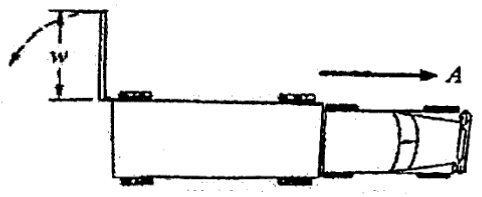
A truck at rest has one door fully open, as shown below. The truck accelerates forward at constant rate $ A $, and the door begins to swing shut. The door is uniform and solid, has total mass $ M $, height $ h $, and width $ w $. Neglect air resistance. Find the instantaneous angular velocity of the door about its hinges when it has swung through $ 90^{\circ} $.
Using cylindrical coordinate system, find out the volume of a cylinder of radius $ R $ and height $ H $.
Q.4 Solve this question :
What are conservative and non-conservative forces? Show that the electrostatic force between two charges $ q_1 $ and $ q_2 $ placed at a distance of $ r $ are conservative. Also, obtain an expression for the potential energy of two charges.
Q.5 Solve both questions :
State and discuss Kepler's law. Show that the Newton's law can be deduced from Kepler's law.
Discuss the energy equation in the centre of mass system.
Q.6 Solve both questions :
Derive Euler's equations of rigid body motion and discuss their necessity in describing rigid body.
Explain, why flying saucers make better spacecraft than do flying cigars.
Q.7 Solve both questions :
Discuss three-dimensional rigid body motion describing angular velocity and moment of inertia tensor.
A thin hoop of mass $ M $ and radius $ R $ rolls without slipping about the z-axis. It is supported by an axle of length $ R $ through its centre. The hoop circles around the z-axis with angular speed $ \Omega $. What is the instantaneous angular velocity of the hoop? Given, the moment of inertia of a hoop for an axis along its diameter is $ \frac{1}{2} MR^2 $.
Q.8 Solve this question :
Discuss three-dimensional rigid body motion describing angular velocity and moment of inertia tensor.
A thin hoop of mass M and radius R rolls without slipping about the z-axis. It is supported by an axle of length R through its centre, as shown below: The hoop circles around the z-axis with angular speed $\omega $. What is the instantaneous angular velocity of the hoop? Given, the moment of inertia of a hoop for an axis along its diameter is$(1/2) MR^2 $.
Q.9 Write short notes on any two of the following:
Instructions:
- The marks are indicated in the right-hand margin.
- There are NINE questions in this paper.
- Attempt FIVE questions in all.
- Question No. 1 is compulsory.
- Symbols used (if any) have their usual meanings.
Q.1 Answer any seven questions :
The position of a particle of mass m under the influence of a free particle is given by $ \vec{r} = A \sin \omega t \, i + B \cos \omega t \, j $. Find the expression for its momentum.
Express $ \vec{r} $ of spherical coordinate system into unit vectors of Cartesian coordinate system.
Give two examples of non-conservative forces.
Define Euler angles.
Consider a cloud of point particles interacting through gravitational forces and having a distribution of kinetic energy. What is the conditioner potential energy under which this cloud will contract?
How long will it take the plane of oscillation of a Foucault pendulum to make one complete revolution if the pendulum is rotated at north pole?
The natural frequency of a mass vibrating on a spring is 20 Hz while its frequency with damping is 16 Hz. Find logarithmic decrement.
If in an electric circuit $ L = 10^{-2} \, H $ and $ C = 20 \times 10^{-6} \, F $, deduce its frequency of oscillations.
Write down the expression for moment of inertia of a ring, axis passing through the centre and perpendicular to its plane.
Define angular velocity vector.
Q.2 Solve both questions :
A particle moves in a circle of radius $ b $ with angular velocity $ \theta = at $, where $ a $ (rad / sec²) is a constant. Describe the particle's velocity in polar coordinates.
Three freight cars of mass $ M $ are pulled with force $ F $ by a locomotive. Priction is negligible. Find the forces on each car.
Q.3 Solve both questions :
Derive length, area and volume elements in spherical coordinate system.
The motion of a particle is observed for 10 seconds and is found to be in accordance with the following equation : $ r = R $ (constant), $ \theta = \left( \frac{\pi}{12} \right)t $ and $ \phi = \pi t $. What will be its velocity?
Q.4 Solve both questions :
A force is said to be conservative if $ \oint \vec{F} \cdot d \vec{r} = 0 $. Show that this condition can also be written as curl $ F = 0 $.
Prove that the electrostatic forces between two charges are conservative.
Q.5 Solve both questions :
What do you mean by equipotential surfaces? Find out the gravitational potential due to a thin spherical shell.
Find the spherical surface of zero potential due to +2q and -3q charges fixed at $ \{4, 0, 0\} $ and $ \{9, 0, 0\} $ respectively.
Q.6 Solve this question :
Write and solve equation of motion of a mass executing simple harmonic oscillator in the presence of a damping force. Also, discuss the cases of overdamping, critically-damping and underdamping oscillations.
Q.7 Solve this question :
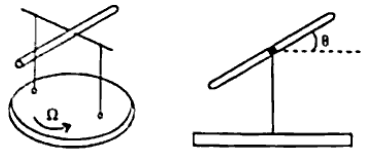
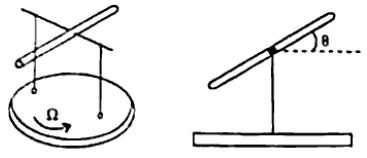
Derive Euler's equations of rigid body motion. Consider a uniform rod mounted on a horizontal frictionless axle through its centre. The axle is carried on a turntable revolving with constant angular velocity $ \Omega $ with the centre of the rod over the axis of the turntable. Let $ \theta $ be the angle shown in the sketch. Using Euler's equations, show that the motion of the rod is simple harmonic.
Q.8 Write short notes on any two of the following :
Q.9 Write short notes on any two of the following :
Instructions:
- The marks are indicated in the right-hand margin.
- There are NINE questions in this paper.
- Attempt FIVE questions in all.
- Question No. 1 is compulsory.
- Symbols used (if any) have their usual meanings.
Q.1 Answer any seven questions :
The position of a particle of mass m under the influence of a free particle is given by $ \vec{r} = A \sin \omega t \, i + B \cos \omega t \, j $. Find the expression for its momentum.
Express $ \vec{r} $ of spherical coordinate system into unit vectors of Cartesian coordinate system.
Give two examples of non-conservative forces.
Define Euler angles.
Consider a cloud of point particles interacting through gravitational forces and having a distribution of kinetic energy. What is the conditioner potential energy under which this cloud will contract?
How long will it take the plane of oscillation of a Foucault pendulum to make one complete revolution if the pendulum is rotated at north pole?
The natural frequency of a mass vibrating on a spring is 20 Hz while its frequency with damping is 16 Hz. Find logarithmic decrement.
If in an electric circuit $ L = 10^{-2} \, H $ and $ C = 20 \times 10^{-6} \, F $, deduce its frequency of oscillations.
Write down the expression for moment of inertia of a ring, axis passing through the centre and perpendicular to its plane.
Define angular velocity vector.
Q.2 Solve both questions :
A particle moves in a circle of radius $ b $ with angular velocity $ \theta = at $, where $ a $ (rad / sec²) is a constant. Describe the particle's velocity in polar coordinates.
Three freight cars of mass $ M $ are pulled with force $ F $ by a locomotive. Priction is negligible. Find the forces on each car.
Q.3 Solve both questions :
Derive length, area and volume elements in spherical coordinate system.
The motion of a particle is observed for 10 seconds and is found to be in accordance with the following equation : $ r = R $ (constant), $ \theta = \left( \frac{\pi}{12} \right)t $ and $ \phi = \pi t $. What will be its velocity?
Q.4 Solve both questions :
A force is said to be conservative if $ \oint \vec{F} \cdot d \vec{r} = 0 $. Show that this condition can also be written as curl $ F = 0 $.
Prove that the electrostatic forces between two charges are conservative.
Q.5 Solve both questions :
What do you mean by equipotential surfaces? Find out the gravitational potential due to a thin spherical shell.
Find the spherical surface of zero potential due to +2q and -3q charges fixed at $ \\{4, 0, 0\\} $ and $ \\{9, 0, 0\\} $ respectively.
Q.6 Solve this question :
Write and solve equation of motion of a mass executing simple harmonic oscillator in the presence of a damping force. Also, discuss the cases of overdamping, critically-damping and underdamping oscillations.
Q.7 Solve this question :
Derive Euler's equations of rigid body motion. Consider a uniform rod mounted on a horizontal frictionless axle through its centre. The axle is carried on a turntable revolving with constant angular velocity $ \Omega $ with the centre of the rod over the axis of the turntable. Let $ \theta $ be the angle shown in the sketch. Using Euler's equations, show that the motion of the rod is simple harmonic.