Instructions:
- The marks are indicated in the right-hand margin.
- There are NINE questions in this paper.
- Attempt FIVE questions in all.
- Question No. 1 is compulsory.
Q.1 Choose the correct answer of the following (Any seven question
only):
In order to determine the effects of a force acting on a body, we must know
A rigid body is in equilibrium if sum of all the
Free-body diagram means
The unit of power in S.I. units
The coefficient of friction depends upon
A propped cantilever will have _____ redundant reaction.
According to Lami's theorem, the three forces
The term 'virtual work' refers to
Theorem of perpendicular axis is used in obtaining the moment of inertia of a
Which of the following statements is false about trusses?
Q.2 Solve both questions :
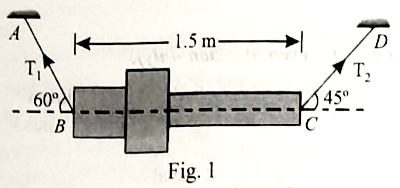
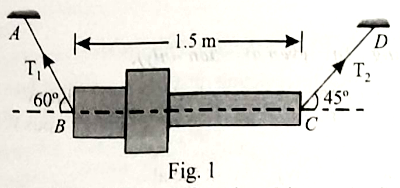
A machine component 1.5 m long and weight 1000 N is supported by two ropes AB and CD as shown in Fig. 1 given below. Calculate the tensions $ T_1 and T_2 $ in the ropes AB and CD.
Show that the algebraic sum of the resolved part of a number of forces in a given direction, is equal to the resolved part of their resultant in the same direction.
Q.3 Solve this question :
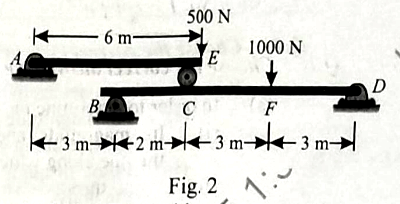
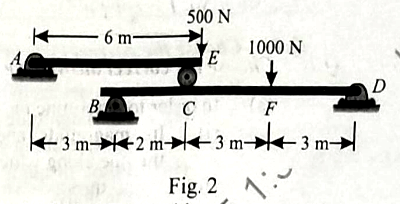
State the principle of virtual work, and explain how it can be used for solving problems in statics. Two beams AE and BD are supported on rollers at B and C as shown in Figure. Determine the reactions at the rollers B and C, using the method of virtual work.
Q.4 Solve both questions :
State the laws of motion. Discuss the first law in the light of second law.
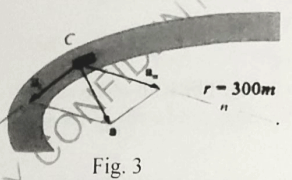
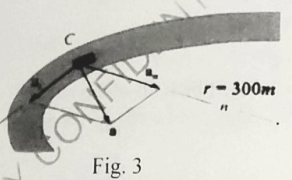
A race car travels around a circular track that has a radius of 300 m. If the car increases its speed at a constant rate of $ 7 m/s^2 $ starting from rest, determine the time needed for it to reach an acceleration of $ 10 m/s^2 $.
Q.5 Solve this question :
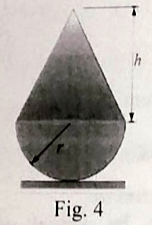
A body consisting of a cone and a hemisphere of radius r fixed on the same base, rests on a table. Find the greatest height h of the cone, so that the combined body may stand upright.
Q.6 Solve both questions :
What is a frame? Discuss its classification. Distinguish between a perfect frame and an imperfect frame.
Find the moment of inertia of a hollow sphere with respect to a diameter if the unit weight of the material is $ gamma $ and if the outer and inner radii are $ r_o $ and $ r_i $, respectively.
Q.7 Solve both questions :
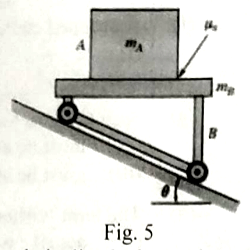
The coefficient of static friction between the block A and the cart B is $ mu $. If the assembly is released from rest on the inclined plane, determine the smallest value of $ mu $ that will prevent the block from sliding on the cart. Find the answer as a function of $ heta $.
State and explain D'Alembert's principle.
Q.8 Solve this question :
A uniform disc of radius r is allowed to roll down a rough inclined plane whose angle of inclination with the horizontal is $ \theta $. Prove that the linear acceleration of the disc is given by: $ a = \frac{g \sin \theta}{\frac{r^2 + k^2}{r^2}} $ where k is the radius of gyration.
Q.9 Write short notes on any two of the following:
Instructions:
- The marks are indicated in the right-hand margin.
- There are NINE questions in this paper.
- Attempt FIVE questions in all.
- Question No. 1 is compulsory.
Q.1 Choose the correct answer of the following (Any seven question
only):
In order to determine the effects of a force acting on a body, we must know
A rigid body is in equilibrium if sum of all the
Free-body diagram means
The unit of power in S.I. units
The coefficient of friction depends upon
A propped cantilever will have _____ redundant reaction.
According to Lami's theorem, the three forces
The term 'virtual work' refers to
Theorem of perpendicular axis is used in obtaining the moment of inertia of a
Which of the following statements is false about trusses?
Q.2 Solve both questions :
A machine component 1.5 m long and weight 1000 N is supported by two ropes AB and CD as shown in Fig. 1 given below. Calculate the tensions $ T_1 and T_2 $ in the ropes AB and CD.
Show that the algebraic sum of the resolved part of a number of forces in a given direction, is equal to the resolved part of their resultant in the same direction.
Q.3 Solve this question :
State the principle of virtual work, and explain how it can be used for solving problems in statics. Two beams AE and BD are supported on rollers at B and C as shown in Figure. Determine the reactions at the rollers B and C, using the method of virtual work.
Q.4 Solve both questions :
State the laws of motion. Discuss the first law in the light of second law.
A race car travels around a circular track that has a radius of 300 m. If the car increases its speed at a constant rate of $ 7 m/s^2 $ starting from rest, determine the time needed for it to reach an acceleration of $ 10 m/s^2 $.
Q.5 Solve this question :
A body consisting of a cone and a hemisphere of radius r fixed on the same base, rests on a table. Find the greatest height h of the cone, so that the combined body may stand upright.
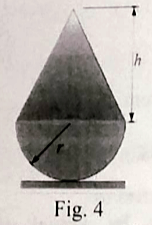
Q.6 Solve both questions :
What is a frame? Discuss its classification. Distinguish between a perfect frame and an imperfect frame.
Find the moment of inertia of a hollow sphere with respect to a diameter if the unit weight of the material is $ gamma $ and if the outer and inner radii are $ r_o $ and $ r_i $, respectively.
Q.7 Solve both questions :
The coefficient of static friction between the block A and the cart B is $ mu $. If the assembly is released from rest on the inclined plane, determine the smallest value of $ mu $ that will prevent the block from sliding on the cart. Find the answer as a function of $ heta $.
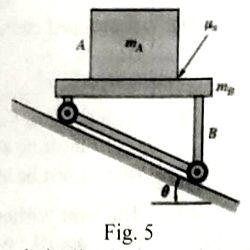
State and explain D'Alembert's principle.
Q.8 Solve this question :
A uniform disc of radius r is allowed to roll down a rough inclined plane whose angle of inclination with the horizontal is $ \theta $. Prove that the linear acceleration of the disc is given by: $ a = \frac{g \sin \theta}{\frac{r^2 + k^2}{r^2}} $ where k is the radius of gyration.
Q.9 Write short notes on any two of the following:
Instructions:
- The marks are indicated in the right-hand margin.
- There are NINE questions in this paper.
- Attempt FIVE questions in all.
- Question No. 1 is compulsory.
Q.1 Choose the correct answer of the following (any seven question
only):
$ C_1 = \begin{bmatrix} 1 & 0 & 0 \ 0 & 1 & 0 \ 0 & 0 & 1 \end{bmatrix} $ is an identity matrix then it is equivalent to perform rotation
Two cylinders have the same mass and radius. One is hollow and the other is solid. Which one will have the greater moment of inertia about the central axis?
Single force and a couple acting in the same plane upon a rigid body
If the masses of both the bodies, as shown in the figure, are doubled, then the acceleration in the string will be

The total energy possessed by a system of moving bodies
Principle of transmissibility for free body diagrams is:
The maximum frictional force which comes into play when a body just begins to slide over another surface is called
The motion of a particle (distance in metres and time in seconds) is given by the equation $ S = 2t^3 + 3t $. The distance of starting from $ t=0 $, to attain a velocity of $ 9\text{ m/s} $, the particle will have to travel a
A body of weight W is placed on an inclined plane. The angle made by the inclined horizontal, when the body is on the point of moving down is called
When the car moves on road its wheel has
Q.2 Solve both questions :
A 5 m ladder weighing 250 N is placed against a smooth vertical wall with its lower end 3 m away from the wall as shown in fig-1 . If the coefficient of friction between the ladder and the floor is 0.3, show that the ladder will remain in equilibrium in this position.

Block weighing 1000 N is resting on a horizontal surface. The coefficient of friction between the block and the horizontal surface is $ \mu=0.2 $. A vertical cable attached to the block provides partial support as shown in fig-2 . A man can pull horizontally with a force of 100 N. What will be the tension, T (in N) in the cable if the man is just able to move the block to the right?

Q.3 Solve both questions :
A uniform wheel of 600 mm diameter, weighing 10KN rests against a rigid rectangular block of 150mm height as shown in fig-3 . Find the least pull, through the centre of the wheel, required just to turn the wheel over the corner A of the block. Also find the reaction of the block. Take the entire surface to be smooth.

The mass of each ball is 200 grams, and connected by a cord. The length of the cord is 80 cm, and the width of the cord is 40 cm. What is the moment of inertia of the balls about the axis of rotation (Ignore cord's mass)?
Q.4 Solve both questions :
A beam 3m long weighing 400 N is suspended in a Horizontal position by two vertical strings, each of which can withstand a maximum tension of 350 N only as shown in fig-4 . How far a body of 200N weight be placed on the beam, so that one of the strings may just break?

Smooth circular cylinder of radius 0.25 meter is lying in a triangular groove, one side of which makes $ 30^{\circ} $ angle and the other $ 45^{\circ} $ angle with the horizontal. Find the reactions at the surfaces of contact, if there is no friction and the cylinder weights 100 N.
Q.5 Solve this question :
A 8 m long simply supported beam with overhangs, rests on supports 4m apart. The left end overhanging is 3 m. The beam carries load of 20 kN and 10 kN on the left and the right ends respectively. Draw S.F.D & B.M.D. Locate point of contraflexure, if any.
Q.6 Solve both questions :
Obtain the metric tensor for two dimensional plane in polar coordinates.
Show that any tensor of rank 2 can be expressed as sum of a symmetric and an antisymmetric tensors of rank 2.
Q.7 Solve both questions :
The angular velocity of the rigid body is defined by the vector: $ W=w_1 i+w_2 j+w_3 k $. Obtain an expression for this angular velocity in terms of the Euler angles, $ \theta $, $ \phi $ and $ \psi $ in the i, j, and k directions.
A car moving with a velocity of 10 m/s shows down in such a manner that the relation between velocity and time is given by: $ v = 10-t^2-\frac{t^3}{2} $. Find the distance travelled in two seconds, average velocity and average retardation of the car in these two seconds.
Q.8 Solve both questions :
A man weighing 750 N stands on the floor of a lift. Find the pressure exerted on the floor when (a) the lift moves upwards with an acceleration of $ 3\text{ m/sec}^2 $ and (b) the lift moves downwards with an acceleration of $ 3\text{ m/sec}^2 $.
A solid shaft transmits 200 kW of power at 600 rpm. Determine the suitable diameter of the shaft if the shear stress is not to exceed 70 MPa and total angle of twist is limited to $ 3^{\circ} $ for 4m length of the shaft, Modulus of rigidity (G) = 80 GPa.
Q.9 Write short notes on any two of the following:
Instructions:
- The marks are indicated in the right-hand margin.
- There are NINE questions in this paper.
- Attempt FIVE questions in all.
- Question No. 1 is compulsory.
Q.1 Choose the correct answer of the following (any seven question
only):
$ C_1 = \begin{bmatrix} 1 & 0 & 0 \ 0 & 1 & 0 \ 0 & 0 & 1 \end{bmatrix} $ is an identity matrix then it is equivalent to perform rotation
Two cylinders have the same mass and radius. One is hollow and the other is solid. Which one will have the greater moment of inertia about the central axis?
Single force and a couple acting in the same plane upon a rigid body
If the masses of both the bodies, as shown in the figure, are doubled, then the acceleration in the string will be
The total energy possessed by a system of moving bodies
Principle of transmissibility for free body diagrams is:
The maximum frictional force which comes into play when a body just begins to slide over another surface is called
The motion of a particle (distance in metres and time in seconds) is given by the equation $ S = 2t^3 + 3t $. The distance of starting from $ t=0 $, to attain a velocity of $ 9\text{ m/s} $, the particle will have to travel a
A body of weight W is placed on an inclined plane. The angle made by the inclined horizontal, when the body is on the point of moving down is called
When the car moves on road its wheel has
Q.2 Solve both questions :
A 5 m ladder weighing 250 N is placed against a smooth vertical wall with its lower end 3 m away from the wall as shown in fig-1 . If the coefficient of friction between the ladder and the floor is 0.3, show that the ladder will remain in equilibrium in this position.
Block weighing 1000 N is resting on a horizontal surface. The coefficient of friction between the block and the horizontal surface is $ \mu=0.2 $. A vertical cable attached to the block provides partial support as shown in fig-2 . A man can pull horizontally with a force of 100 N. What will be the tension, T (in N) in the cable if the man is just able to move the block to the right?
Q.3 Solve both questions :
A uniform wheel of 600 mm diameter, weighing 10KN rests against a rigid rectangular block of 150mm height as shown in fig-3 . Find the least pull, through the centre of the wheel, required just to turn the wheel over the corner A of the block. Also find the reaction of the block. Take the entire surface to be smooth.
The mass of each ball is 200 grams, and connected by a cord. The length of the cord is 80 cm, and the width of the cord is 40 cm. What is the moment of inertia of the balls about the axis of rotation (Ignore cord's mass)?
Q.4 Solve both questions :
A beam 3m long weighing 400 N is suspended in a Horizontal position by two vertical strings, each of which can withstand a maximum tension of 350 N only as shown in fig-4 . How far a body of 200N weight be placed on the beam, so that one of the strings may just break?
Smooth circular cylinder of radius 0.25 meter is lying in a triangular groove, one side of which makes $ 30^{\circ} $ angle and the other $ 45^{\circ} $ angle with the horizontal. Find the reactions at the surfaces of contact, if there is no friction and the cylinder weights 100 N.
Q.5 Solve this question :
A 8 m long simply supported beam with overhangs, rests on supports 4m apart. The left end overhanging is 3 m. The beam carries load of 20 kN and 10 kN on the left and the right ends respectively. Draw S.F.D & B.M.D. Locate point of contraflexure, if any.
Q.6 Solve both questions :
Obtain the metric tensor for two dimensional plane in polar coordinates.
Show that any tensor of rank 2 can be expressed as sum of a symmetric and an antisymmetric tensors of rank 2.
Q.7 Solve both questions :
The angular velocity of the rigid body is defined by the vector: $ W=w_1 i+w_2 j+w_3 k $. Obtain an expression for this angular velocity in terms of the Euler angles, $ \theta $, $ \phi $ and $ \psi $ in the i, j, and k directions.
A car moving with a velocity of 10 m/s shows down in such a manner that the relation between velocity and time is given by: $ v = 10-t^2-\frac{t^3}{2} $. Find the distance travelled in two seconds, average velocity and average retardation of the car in these two seconds.
Q.8 Solve both questions :
A man weighing 750 N stands on the floor of a lift. Find the pressure exerted on the floor when (a) the lift moves upwards with an acceleration of $ 3\text{ m/sec}^2 $ and (b) the lift moves downwards with an acceleration of $ 3\text{ m/sec}^2 $.
A solid shaft transmits 200 kW of power at 600 rpm. Determine the suitable diameter of the shaft if the shear stress is not to exceed 70 MPa and total angle of twist is limited to $ 3^{\circ} $ for 4m length of the shaft, Modulus of rigidity (G) = 80 GPa.
Q.9 Write short notes on any two of the following:
Instructions:
- The marks are indicated in the right-hand margin.
- There are NINE questions in this paper.
- Attempt FIVE questions in all.
- Question No. 1 is compulsory.
Questions
Choose the correct answer of the following (any seven question only):
Answer the following:
Answer the following:
Answer the following:
Answer the following:
Answer the following:
Answer the following:
Answer the following:
Answer the following:
Instructions:
- The marks are indicated in the right-hand margin.
- There are NINE questions in this paper.
- Attempt FIVE questions in all.
- Question No. 1 is compulsory.
Questions
Choose the correct answer of the following (Any seven question only):
Answer the following:
Answer the following:
Answer the following:
Answer the following:
Answer the following:
Answer the following:
Answer the following:
Answer the following:
Instructions:
- The marks are indicated in the right-hand margin.
- There are NINE questions in this paper.
- Attempt FIVE questions in all.
- Question No. 1 is compulsory.
Questions
Choose the correct answer of the following (Any seven question only):
Answer the following:
Fig. 2 shows the cross-section of a cast iron beam. Determine the moments of inertia of the section about horizontal and vertical axes passing through the centroid of the section.
Answer the following:
Answer the following:
Answer the following:
Answer the following:
Answer the following:
Answer the following:
Instructions:
- The marks are indicated in the right-hand margin.
- There are NINE questions in this paper.
- Attempt FIVE questions in all.
- Question No. 1 is compulsory.
Q.1 Choose the correct answer (any seven):
A body of mass m moving with a constant velocity v strikes another body of same mass moving with same velocity but in opposite direction. The common velocity of both the bodies after collision is
The centre of percussion of the homogeneous rod of length L suspended at the top will be
The figure given below shows the three coplanar forces P, Q and R acting at a point O. If these forces are in equilibrium, then

The angle of inclination of the plane at which the body begins to move down the plane, is called
Pick up wrong statement about friction force for dry surfaces. Friction force is
The term 'centroid' is
The CG of a plane lamina will not be at its geometrical centre in the case of a
If the masses of both the bodies, as shown in the figure below are reduced to 50 percent then tension in the string will be
Forces are called coplanar when all of them acting on body lie in
A weight of 1000 N can be lifted by an effort of 80 N. If the velocity ratio is 20, then the machine is
Q.2 Solve both questions :
Four forces of magnitude 10 N, 20 N, 30 N and 40 N are acting respectively along the four sides of a square ABCD as shown in Fig. 1. Determine the resultant moment about the point A. Each side of the square is given 2 m.

Three like parallel forces 100 N, 200 N and 300 N are acting at points A, B and C respectively on a straight line ABC as shown in Fig. 2. The distances are AB = 30 cm and BC = 40 cm. Find the resultant and also the distance of the resultant from point A on line ABC.

Q.3 Solve both questions :
Fig. 3 shows a sphere resting in a smooth V-shaped groove and subjected to a spring force. The spring is compressed to a length of 100 mm from the free length of 150 mm. If the stiffness of the spring is $ 2\text{ N/mm} $, determine the contact reaction at A and B.

Using the analytical method, determine the centre of gravity of the plane uniform lamina as shown in Fig. 4.

Q.4 Solve both questions :
Explain the conditions for equilibrium of forces in space.
show that $ I_O = I_G + Ah^2 $, where $ I_G $ is the moment of inertia of a lamina about an axis through its centroid and lying in its plane and h is the distance from the centroid to a parallel axis in the same plane about which its moment of inertia is $ I_O $. A being the area of the lamina.
Q.5 Solve both questions :
Find the least force required to pull a body of weight W placed on a rough horizontal plane, when the force is applied at an angle $ \theta $ with the horizontal.
A cord connects two bodies of weights 500 N and 1000 N. The two bodies are placed on an inclined plane and cord is parallel to inclined plane. The coefficients of friction for the weight of 500 N is 0.20 and that of 1000 N is 0.4. Determine the inclination of the plane to the horizontal and tension in the cord, when the motion is about to take place, down the inclined plane. The body weight 500 N is below the body weighing 1000 N.
Q.6 Solve both questions :
A truss of span 9 m is loaded as shown in Fig. 5. Find the reactions and forces in the members marked.

Define and explain the terms 'perfect frame', 'imperfect frame', 'deficient frame' and 'redundant frame'.
Q.7 Solve both questions :
Each of the two uniform hinged bars in Fig. 6 has a mass m and a length l, and is supported and loaded as shown below. For a given force P, determine the angle $ \theta $ for equilibrium.

The mass of the uniform bar of length l in Fig. 7 is m while that of the uniform bar of length 2l is 2m shown below. For a given force P, determine the angle for equilibrium.

Q.8 Solve both questions :
A wheel is rotating about its axis with a constant angular acceleration of $ 1\text{ rad/s}^2 $. If the initial and final angular velocities are $ 5.25\text{ rad/s} $ and $ 10.5\text{ rad/s} $, determine the total angle turned through during the time interval this change of angular velocity took place.
(i) A flywheel starts rotating from rest and is given an acceleration of $ 1\text{ rad/s}^2 $. Find the angular velocity and speed in r.p.m. after 1.5 minutes. (ii) If the flywheel is brought to rest with a uniform angular retardation of $ 0.5\text{ rad/s}^2 $, determine the time taken by the flywheel in seconds to come to rest.
Q.9 Solve all three questions:
State and prove Varignon's theorem.
Derive the equation of path of a projectile and hence show the equation of path of projectile is a parabolic curve.
A particle is moving in X-Y plane and its position is defined by $ \vec{r} = (\frac{3}{2}t^2)\hat{i} + (\frac{2}{3}t^3)\hat{j} $. Find radius of curvature, when $ t=2 $ sec.
Instructions:
- The marks are indicated in the right-hand margin.
- There are NINE questions in this paper.
- Attempt FIVE questions in all.
- Question No. 1 is compulsory.
Q.1 Choose the correct answer (any seven):
A body of mass m moving with a constant velocity v strikes another body of same mass moving with same velocity but in opposite direction. The common velocity of both the bodies after collision is
The centre of percussion of the homogeneous rod of length L suspended at the top will be
The figure given below shows the three coplanar forces P, Q and R acting at a point O. If these forces are in equilibrium, then
The angle of inclination of the plane at which the body begins to move down the plane, is called
Pick up wrong statement about friction force for dry surfaces. Friction force is
The term 'centroid' is
The CG of a plane lamina will not be at its geometrical centre in the case of a
If the masses of both the bodies, as shown in the figure below are reduced to 50 percent then tension in the string will be
Forces are called coplanar when all of them acting on body lie in
A weight of 1000 N can be lifted by an effort of 80 N. If the velocity ratio is 20, then the machine is
Q.2 Solve both questions :
Four forces of magnitude 10 N, 20 N, 30 N and 40 N are acting respectively along the four sides of a square ABCD as shown in Fig. 1. Determine the resultant moment about the point A. Each side of the square is given 2 m.
Three like parallel forces 100 N, 200 N and 300 N are acting at points A, B and C respectively on a straight line ABC as shown in Fig. 2. The distances are AB = 30 cm and BC = 40 cm. Find the resultant and also the distance of the resultant from point A on line ABC.
Q.3 Solve both questions :
Fig. 3 shows a sphere resting in a smooth V-shaped groove and subjected to a spring force. The spring is compressed to a length of 100 mm from the free length of 150 mm. If the stiffness of the spring is $ 2\text{ N/mm} $, determine the contact reaction at A and B.
Using the analytical method, determine the centre of gravity of the plane uniform lamina as shown in Fig. 4.
Q.4 Solve both questions :
Explain the conditions for equilibrium of forces in space.
show that $ I_O = I_G + Ah^2 $, where $ I_G $ is the moment of inertia of a lamina about an axis through its centroid and lying in its plane and h is the distance from the centroid to a parallel axis in the same plane about which its moment of inertia is $ I_O $. A being the area of the lamina.
Q.5 Solve both questions :
Find the least force required to pull a body of weight W placed on a rough horizontal plane, when the force is applied at an angle $ \theta $ with the horizontal.
A cord connects two bodies of weights 500 N and 1000 N. The two bodies are placed on an inclined plane and cord is parallel to inclined plane. The coefficients of friction for the weight of 500 N is 0.20 and that of 1000 N is 0.4. Determine the inclination of the plane to the horizontal and tension in the cord, when the motion is about to take place, down the inclined plane. The body weight 500 N is below the body weighing 1000 N.
Q.6 Solve both questions :
A truss of span 9 m is loaded as shown in Fig. 5. Find the reactions and forces in the members marked.
Define and explain the terms 'perfect frame', 'imperfect frame', 'deficient frame' and 'redundant frame'.
Q.7 Solve both questions :
Each of the two uniform hinged bars in Fig. 6 has a mass m and a length l, and is supported and loaded as shown below. For a given force P, determine the angle $ \theta $ for equilibrium.
The mass of the uniform bar of length l in Fig. 7 is m while that of the uniform bar of length 2l is 2m shown below. For a given force P, determine the angle for equilibrium.
Q.8 Solve both questions :
A wheel is rotating about its axis with a constant angular acceleration of $ 1\text{ rad/s}^2 $. If the initial and final angular velocities are $ 5.25\text{ rad/s} $ and $ 10.5\text{ rad/s} $, determine the total angle turned through during the time interval this change of angular velocity took place.
(i) A flywheel starts rotating from rest and is given an acceleration of $ 1\text{ rad/s}^2 $. Find the angular velocity and speed in r.p.m. after 1.5 minutes. (ii) If the flywheel is brought to rest with a uniform angular retardation of $ 0.5\text{ rad/s}^2 $, determine the time taken by the flywheel in seconds to come to rest.
Q.9 Solve all three questions:
State and prove Varignon's theorem.
Derive the equation of path of a projectile and hence show the equation of path of projectile is a parabolic curve.
A particle is moving in X-Y plane and its position is defined by $ \vec{r} = (\frac{3}{2}t^2)\hat{i} + (\frac{2}{3}t^3)\hat{j} $. Find radius of curvature, when $ t=2 $ sec.
Instructions:
- The marks are indicated in the right-hand margin.
- There are NINE questions in this paper.
- Attempt FIVE questions in all.
- Question No. 1 is compulsory.
Questions
Choose the correct answer from the following (any seven):
Prove that the projection of a sum of vectors onto any axis equals the sum of the projections of the vectors onto the same axis.
Two smooth (frictionless) cylinders and of weight and radius each are kept in a horizontal channel of width ($b < 4r$) as shown in Fig. 1 below: Find the reaction forces coming from the two sides and the bottom of the channel as well as the forces exerted by the cylinders to each other, assuming the channel walls also to be smooth. Take , and .
Show that the sum of the moments of inertia of a body, , is independent of the orientation of the axes and thus depends only on the location of its origin.
Rod presses against , giving it an angular velocity. If the angular velocity of is maintained at , determine the required magnitude of the velocity of as a function of the angle of rod (Fig. 2):
Determine the maximum shear stress developed in the diameter shaft shown in Fig. 3 below:
Determine the internal normal force, shear force and moment at points and in the compound beam. Point is located just to the left of the concentrated load. Assume the support at is fixed and the connection at is a pin (Fig. 4):
The coefficient of friction between the block ($80\text{ kg}$) and the inclined rail shown in Fig. 5 below are and : Determine the smallest values of required, for the following conditions: (a) To start the block up the rail (b) To keep it moving (c) To prevent it moving down
Write short notes on the following with suitable mathematical expressions: (a) Kinetic friction (b) Newton-Euler laws of motion (c) Gyroscopic motions (d) Principal moment of inertia and axes of inertia
Instructions:
- The marks are indicated in the right-hand margin.
- There are NINE questions in this paper.
- Attempt FIVE questions in all.
- Question No. 1 is compulsory.
Questions
Choose the correct option (any seven):
Answer the following:
The solid cylindrical rotor has a mass of and is mounted on its central axis as shown in Fig. 2. The frame rotates about the fixed vertical axis under the applied torque . The rotor may be unlocked from the frame by withdrawing the locking pin . Calculate the angular acceleration of the frame if the locking pin is (a) in place and (b) withdrawn. Neglect all friction and the mass of the frame.
What is space truss? Determine the force in each member of the truss shown in Fig. 3 and state if the members are in tension or compression.
Answer the following:
Determine the centroid and moment of inertia about both and axis for the beam's cross-section shown in Fig. 5.
Answer the following:
Answer the following:
Answer the following:
Instructions:
- The marks are indicated in the right-hand margin.
- There are NINE questions in this paper.
- Attempt FIVE questions in all.
- Question No. 1 is compulsory.
Q.1 Choose the correct answer (any seven):
The coefficient of friction depends upon
Which of the following is a vector quantity?
Moment of inertia of a hollow rectangular section as shown in the figure below about X-X axis is

The moment of a force
A heavy string attached at two ends at same horizontal level and when central dip is very small approaches
The centre of gravity, a T-section $ 100\text{ mm} \times 150\text{ mm} \times 50\text{ mm} $ from its bottom is
Kinetic friction is the
The mechanical advantage of a lifting machine is the ratio of
In ideal machines, mechanical advantage is velocity ratio.
Frictional force encountered after commencement of motion is called
Q.2 Solve both questions :
A force of 100 N is acting at a point A as shown in Fig. 1. Determine the moments of this force about O.

The cable AB prevents bar OA from rotating clockwise about the pivot O shown in Fig. 2. If the cable tension is 750 N, determine the n- and t-components of this force acting on point A of the bar.

Q.3 Solve both questions :
A lamp weighing 5 N is suspended from the ceiling by a chain. It is pulled aside by a horizontal cord until the chain makes an angle of $ 60^{\circ} $ with the ceiling as shown in Fig. 3. Find the tensions in the chain and the cord by applying Lami's theorem.

A roller of radius 40 cm, weighing 3000 N is to be pulled over rectangular block of height 20 cm as shown in Fig. 4, by a horizontal force applied at the end of a string wound round the circumference of the roller. Find the magnitude of the horizontal force which will just turn the roller over the corner of the rectangular block. Also, determine the magnitude and direction of reactions at A and B. All surfaces may be taken as smooth.

Q.4 Solve both questions :
In Fig. 5, the coefficient of friction is 0.2 between the rope and fixed pulley and between other surfaces of contact, $ \mu = 0.3 $. Determine the minimum weight W to prevent the downward motion of the 100 N body.

A body of weight 60 N is placed on a rough horizontal plane. To just move the body on the horizontal plane, a push of 18 N inclined at $ 20^{\circ} $ to the horizontal plane is required. Find the coefficient of friction.
Q.5 Solve both questions :
Determine the support reactions and nature, and magnitude of forces in the members of truss shown in Fig. 6.

What are the different methods of analyzing (or finding out the forces) a perfect frame? Which one is used where and why?
Q.6 Solve both questions :
Prove that the moment of inertia of a circular section about a horizontal axis (in the plane of the circular section) and passing through the CG of the section is given by $ \pi D^4/64 $.
From a rectangular lamina ABCD, 10 cm x 14 cm a rectangular hole of 3 cm x 5 cm is cut as shown in Fig. 7. Find the centre of gravity of the remainder lamina.

Q.7 Solve both questions :
The spring of constant k in Fig. 8 is unstretched when force P = 0. Derive an expression for the force P required to deflect the system to an angle $ \theta $. The mass of the bars is negligible.

For link OA in the horizontal position shown in Fig. 9, determine the force P on the sliding collar which will prevent OA from rotating under the action of the couple M. Neglect the mass of the moving parts.

Q.8 Solve both questions :
A particle moves in x-y plane with acceleration components $ a_x = -3\text{ m/s}^2 $ and $ a_y = -16t\text{ m/s}^2 $. If its initial velocity is $ V_0 = 50\text{ m/s} $ directed at $ 35^{\circ} $ to the x-axis, compute the radius of curvature of the path at $ t=2 $ sec.
A force of magnitude of 20 kN, acts at point A (3,4,5) m and has its line of action passing through B (5, -3, 4) m. Calculate the moment of this force about a line passing through points S (2,-5,3) m and T (-3,4,6) m.
Q.9 Solve both questions :
Three forces F1, F2 and F3 act at the origin of Cartesian coordinate axes system. The force $ F1 (=70N) $ acts along OA whereas $ F2 (=80\text{ N}) $ acts along OB and $ F3 (=100\text{ N}) $ acts along OC. The coordinates of the points A, B and C are (2, 1, 3), (-1, 2, 0) and (4, 1, 5) respectively. Find the resultant of this force system.
A 75 kg person stands on a weighing scale in an elevator. 3 seconds after the motion starts from rest, the tension in the hoisting cable was found to be 8300 N. Find the reading of the scale in kg during this interval. Also, find the velocity of the elevator at the end of this interval. The total mass of the elevator, including mass of the person and weighing scale is 750 kg. If the elevator is now moving in the opposite direction, with same magnitude of acceleration, what will be the new reading of the scale?
Instructions:
- The marks are indicated in the right-hand margin.
- There are NINE questions in this paper.
- Attempt FIVE questions in all.
- Question No. 1 is compulsory.
Q.1 Choose the correct answer (any seven):
The coefficient of friction depends upon
Which of the following is a vector quantity?
Moment of inertia of a hollow rectangular section as shown in the figure below about X-X axis is
The moment of a force
A heavy string attached at two ends at same horizontal level and when central dip is very small approaches
The centre of gravity, a T-section $ 100\text{ mm} \times 150\text{ mm} \times 50\text{ mm} $ from its bottom is
Kinetic friction is the
The mechanical advantage of a lifting machine is the ratio of
In ideal machines, mechanical advantage is velocity ratio.
Frictional force encountered after commencement of motion is called
Q.2 Solve both questions :
A force of 100 N is acting at a point A as shown in Fig. 1. Determine the moments of this force about O.
The cable AB prevents bar OA from rotating clockwise about the pivot O shown in Fig. 2. If the cable tension is 750 N, determine the n- and t-components of this force acting on point A of the bar.
Q.3 Solve both questions :
A lamp weighing 5 N is suspended from the ceiling by a chain. It is pulled aside by a horizontal cord until the chain makes an angle of $ 60^{\circ} $ with the ceiling as shown in Fig. 3. Find the tensions in the chain and the cord by applying Lami's theorem.
A roller of radius 40 cm, weighing 3000 N is to be pulled over rectangular block of height 20 cm as shown in Fig. 4, by a horizontal force applied at the end of a string wound round the circumference of the roller. Find the magnitude of the horizontal force which will just turn the roller over the corner of the rectangular block. Also, determine the magnitude and direction of reactions at A and B. All surfaces may be taken as smooth.
Q.4 Solve both questions :
In Fig. 5, the coefficient of friction is 0.2 between the rope and fixed pulley and between other surfaces of contact, $ \mu = 0.3 $. Determine the minimum weight W to prevent the downward motion of the 100 N body.
A body of weight 60 N is placed on a rough horizontal plane. To just move the body on the horizontal plane, a push of 18 N inclined at $ 20^{\circ} $ to the horizontal plane is required. Find the coefficient of friction.
Q.5 Solve both questions :
Determine the support reactions and nature, and magnitude of forces in the members of truss shown in Fig. 6.
What are the different methods of analyzing (or finding out the forces) a perfect frame? Which one is used where and why?
Q.6 Solve both questions :
Prove that the moment of inertia of a circular section about a horizontal axis (in the plane of the circular section) and passing through the CG of the section is given by $ \pi D^4/64 $.
From a rectangular lamina ABCD, 10 cm x 14 cm a rectangular hole of 3 cm x 5 cm is cut as shown in Fig. 7. Find the centre of gravity of the remainder lamina.
Q.7 Solve both questions :
The spring of constant k in Fig. 8 is unstretched when force P = 0. Derive an expression for the force P required to deflect the system to an angle $ \theta $. The mass of the bars is negligible.
For link OA in the horizontal position shown in Fig. 9, determine the force P on the sliding collar which will prevent OA from rotating under the action of the couple M. Neglect the mass of the moving parts.
Q.8 Solve both questions :
A particle moves in x-y plane with acceleration components $ a_x = -3\text{ m/s}^2 $ and $ a_y = -16t\text{ m/s}^2 $. If its initial velocity is $ V_0 = 50\text{ m/s} $ directed at $ 35^{\circ} $ to the x-axis, compute the radius of curvature of the path at $ t=2 $ sec.
A force of magnitude of 20 kN, acts at point A (3,4,5) m and has its line of action passing through B (5, -3, 4) m. Calculate the moment of this force about a line passing through points S (2,-5,3) m and T (-3,4,6) m.
Q.9 Solve both questions :
Three forces F1, F2 and F3 act at the origin of Cartesian coordinate axes system. The force $ F1 (=70N) $ acts along OA whereas $ F2 (=80\text{ N}) $ acts along OB and $ F3 (=100\text{ N}) $ acts along OC. The coordinates of the points A, B and C are (2, 1, 3), (-1, 2, 0) and (4, 1, 5) respectively. Find the resultant of this force system.
A 75 kg person stands on a weighing scale in an elevator. 3 seconds after the motion starts from rest, the tension in the hoisting cable was found to be 8300 N. Find the reading of the scale in kg during this interval. Also, find the velocity of the elevator at the end of this interval. The total mass of the elevator, including mass of the person and weighing scale is 750 kg. If the elevator is now moving in the opposite direction, with same magnitude of acceleration, what will be the new reading of the scale?
Instructions:
- The marks are indicated in the right-hand margin.
- There are NINE questions in this paper.
- Attempt FIVE questions in all.
- Question No. 1 is compulsory.
Questions
Answer the following:
Choose the correct answer of the following (any seven) :
Answer the following:
If and are consecutive vectors of a parallelogram, express the diagonal vectors in terms of and .
From the relative tensor of weight , derive a relative scalar of weight .
If are the components of an absolute mixed tensor, show that is a scalar invariant.
Answer the following:
If , find the value of at .
A flywheel is making 180 r.p.m. and after 20 seconds it is running at 120 r.p.m. How many revolutions will it make and what time will elapse before it stops, if the retardation is uniform?
Answer the following:
Explain the term 'instantaneous centre'. How would you locate the instantaneous centre of a rigid link moving with combined motion of rotation and translation?
The bent flat bar rotates about a fixed axis through point . At the instant depicted, its angular properties are and with directions as indicated in Fig. 1 below. Determine the instantaneous velocity and acceleration of point A.
Answer the following:
The sliders and are connected by a light rigid bar and move with negligible friction in the slots, both of which lie in a horizontal plane. For the position shown in Fig. 2 below, the hydraulic cylinder imparts a velocity and acceleration to slider of and , respectively, both to the right. Determine the acceleration of slider and the force in the bar at this instant.
Explain the dynamic equilibrium of a rigid body in plane motion.
Answer the following:
A mass supported by a spring has a static deflection of 0.5 mm. Determine its natural frequency of oscillation.
A simple pendulum of amplitude performs 24 oscillations in one minute. Find (i) length of the pendulum, (ii) maximum acceleration of the bob, (iii) maximum linear velocity of the bob and (iv) maximum angular velocity of the bob.
State the laws of friction.
Answer the following:
What is the difference between the impact of two bodies and the impact of a body on a fixed plane?
A sphere of mass 1 kg, moving at 3 m/s, overtakes another sphere of mass 5 kg, moving in the same line at 60 cm/s. Find the loss of kinetic energy during impact and show that the direction of motion of the first sphere is reversed. Take coefficient of restitution as 0.75.
A ball is dropped from a height of 25 metres upon a horizontal floor. Find the coefficient of restitution between the floor and the ball, if it rebounds to a height of 16 metres.
Answer the following:
A light rope passing round a pulley of mass 60 kg, radius 300 mm and radius of gyration 200 mm, has two masses 8 kg and 6 kg attached to its ends. If the rope does not slip as the pulley rotates, determine the acceleration of the two masses and the pulls in the two ropes.
What is the principle of conservation of momentum for a general mass system?
What is parallel and perpendicular axis theorem?
Answer the following:
Draw the shear and bending moment diagrams for the beam and loading shown in Fig. 3 below.
In a hollow circular shaft of outer and inner diameters of 20 cm and 10 cm respectively, the shear stress is not to exceed . Find the maximum torque which the shaft can safely transmit.
Instructions:
- The marks are indicated in the right-hand margin.
- There are NINE questions in this paper.
- Attempt FIVE questions in all.
- Question No. 1 is compulsory.
Questions
Answer the following:
Choose the correct alternative from any seven of the following :
Find the moment of a force 5 N directed along one side of a cube of side length 2 m with respect to— (a) all vertices of the cube; (b) all axes going through the sides.
Draw the free-body diagram of the 50 kg paper roll which has a center of mass at and rests on the smooth blade of the paper hauler (in Fig. 1). Explain the significance of each force acting on the diagram.
Explain, with due mathematical expression, the mass moment of inertia for an object. Derive the mass moment of inertia about the centroidal axes of a solid sphere, a solid cylinder, and a solid right circular cone.
At the instant shown (in Fig. 2), the disk is rotating with an angular velocity of and has an angular acceleration of . Determine the velocity and acceleration of cylinder at this instant. Neglect the size of the pulley at .
The hollow circular shaft is subjected to an internal torque of (in Fig. 3). Determine the shear stress developed at points and . Represent each state of stress on an element.
Draw shear force and bending moment diagrams for the beam shown (in Fig. 4). Determine the internal normal force, shear force, and moment at points and in the simply supported beam. Point is located just to the left of the 10 kN concentrated load.
If the coefficient of static friction at all contacting surfaces is (in Fig. 5), determine the inclination at which the identical blocks, each of weight , begin to slide.
Write short notes on the following with suitable mathematical expressions: (a) Angle of repose; (b) Types of supports and their reactions; (c) Polar moment of inertia; (d) General planar motion.
Instructions:
- The marks are indicated in the right-hand margin.
- There are NINE questions in this paper.
- Attempt FIVE questions in all.
- Question No. 1 is compulsory.
Questions
Choose the correct answer from the following (any seven):
Answer the following:
Answer the following:
Answer the following:
Answer the following:
Answer the following:
Answer the following:
Answer the following:
Answer the following:
Instructions:
- The marks are indicated in the right-hand margin.
- There are NINE questions in this paper.
- Attempt FIVE questions in all.
- Question No. 1 is compulsory.
Questions
Choose the correct answer of the following (any seven):
Answer the following:
The narrow ring of mass is free to rotate in the vertical plane about as shown in Fig. 2: If the ring is released from rest at , determine the expression for the and components of the force at in terms of .
What is a truss? Determine the force in terms of the load for each member of the truss shown in Fig. 3 and state if the members are in tension or compression:
Answer the following:
Determine the location of the centroid of the channel's cross-section area and also calculate the moment of inertia of the area about the axis shown in Fig. 5:
Answer the following:
Answer the following:
Answer the following:
Instructions:
- The marks are indicated in the right-hand margin.
- There are NINE questions in this paper.
- Attempt FIVE questions in all.
- Question No. 1 is compulsory.
Q.1 Choose the correct answer (any seven):
The resultant of two forces P and Q acting at an angle $ \theta $ is equal to
The moment of a force about any point is geometrically equal to ___ area of the triangle whose base is the line representing the force and vertex is the point about which the moment is taken.
A circular hole of radius (r) is cut out from a circular disc of radius (2r) in such a way that the diagonal of the hole is the radius of the disc. The centre of gravity of the section lies at
The moment of inertia of a triangular section of base (b) and height (h) about an axis passing through its vertex and parallel to the base is ___ as that passing through its CG and parallel to the base.
Which of the following statements is correct?
The efficiency of a screw jack is maximum when the helix angle is equal to
The time of flight of a projectile on an upward inclined plane depends upon
The relationship between linear velocity and angular velocity of a cycle
The loss of kinetic energy due to direct impact of two bodies depends on
In order to increase the acceleration of a mass rolling down on a rough inclined plane (without slipping), we have to
Q.2 Solve all three questions:
What is meant by moment of a force? How will you explain it mathematically?
State the Varignon's principle of moments.
A force F of magnitude 50 N is exerted on the automobile parking-brake lever at the position $ x=250\text{ mm} $ (Fig. 1). Replace the force by an equivalent force-couple system at the pivot point O.

Q.3 Solve both questions :
It is known that a force with a moment of 950 N-m about D is required to straighten the fence post CD (Fig. 2). If $ d=2.70\text{ m} $, determine the tension that must be developed in the cable of winch puller AB to create the required moment about point D.

Describe the method of finding the line of action of the resultant of a system of parallel forces.
Q.4 Solve both questions :
Two cylinders P and Q rest in a channel as shown in Fig. 3. The cylinder P has diameter of 100 mm and weighs 200 N, whereas the cylinder Q has diameter of 180 mm and weighs 500 N. If the bottom width of the box is 180 mm, with one side vertical and the other inclined at $ 60^{\circ} $, determine the pressures at all the four points of contact.

Show that if three coplanar forces, acting at a point be in equilibrium, then each force is proportional to the sine of the angle between the other two.
Q.5 Solve both questions :
A truss of 9 m span is loaded as shown in Fig. 4. Find the reactions at the two supports.

State the laws of friction and explain the term angle of friction.
Q.6 Solve both questions :
A rectangular hole is made in triangular section as shown in Fig. 5. Determine the moment of inertia of the section about X-X axis passing through its centre of gravity and the base BC.

Prove the parallel axis theorem in the determination of moment of inertia of areas with the help of a neat sketch.
Q.7 Solve both questions :
A body of weight 50 N is hauled along a rough horizontal plane by a pull of 18 N acting at an angle of $ 14^{\circ} $ with the horizontal. Find the coefficient of friction.
Explain the application of the principle of virtual work in case of lifting machines.
Q.8 Solve both questions :
The equation of motion of an engine is given by $ s = 2t^3 - 6t^2 - 5 $, where s is in metres and t in seconds. Calculate (i) displacement and acceleration when velocity is zero and (ii) displacement and velocity when acceleration is zero.
Obtain an equation for the trajectory of a projectile and show that it is a parabola.
Q.9 Solve both questions :
A ball of mass 1 kg moving with a velocity of $ 2\text{ m/s} $ impinges directly on a ball of mass 2 kg at rest. The first ball, after impinging, comes to rest. Find the velocity of the second ball after the impact and the coefficient of restitution.
A bullet of mass 30 g is fired into a body of mass 10 kg, which is suspended by a string 0.8 m long. Due to this impact, the body swings through an angle $ 30^{\circ} $. Find the velocity of the bullet.
Instructions:
- The marks are indicated in the right-hand margin.
- There are NINE questions in this paper.
- Attempt FIVE questions in all.
- Question No. 1 is compulsory.
Q.1 Choose the correct answer (any seven):
The resultant of two forces P and Q acting at an angle $ \theta $ is equal to
The moment of a force about any point is geometrically equal to ___ area of the triangle whose base is the line representing the force and vertex is the point about which the moment is taken.
A circular hole of radius (r) is cut out from a circular disc of radius (2r) in such a way that the diagonal of the hole is the radius of the disc. The centre of gravity of the section lies at
The moment of inertia of a triangular section of base (b) and height (h) about an axis passing through its vertex and parallel to the base is ___ as that passing through its CG and parallel to the base.
Which of the following statements is correct?
The efficiency of a screw jack is maximum when the helix angle is equal to
The time of flight of a projectile on an upward inclined plane depends upon
The relationship between linear velocity and angular velocity of a cycle
The loss of kinetic energy due to direct impact of two bodies depends on
In order to increase the acceleration of a mass rolling down on a rough inclined plane (without slipping), we have to
Q.2 Solve all three questions:
What is meant by moment of a force? How will you explain it mathematically?
State the Varignon's principle of moments.
A force F of magnitude 50 N is exerted on the automobile parking-brake lever at the position $ x=250\text{ mm} $ (Fig. 1). Replace the force by an equivalent force-couple system at the pivot point O.
Q.3 Solve both questions :
It is known that a force with a moment of 950 N-m about D is required to straighten the fence post CD (Fig. 2). If $ d=2.70\text{ m} $, determine the tension that must be developed in the cable of winch puller AB to create the required moment about point D.
Describe the method of finding the line of action of the resultant of a system of parallel forces.
Q.4 Solve both questions :
Two cylinders P and Q rest in a channel as shown in Fig. 3. The cylinder P has diameter of 100 mm and weighs 200 N, whereas the cylinder Q has diameter of 180 mm and weighs 500 N. If the bottom width of the box is 180 mm, with one side vertical and the other inclined at $ 60^{\circ} $, determine the pressures at all the four points of contact.
Show that if three coplanar forces, acting at a point be in equilibrium, then each force is proportional to the sine of the angle between the other two.
Q.5 Solve both questions :
A truss of 9 m span is loaded as shown in Fig. 4. Find the reactions at the two supports.
State the laws of friction and explain the term angle of friction.
Q.6 Solve both questions :
A rectangular hole is made in triangular section as shown in Fig. 5. Determine the moment of inertia of the section about X-X axis passing through its centre of gravity and the base BC.
Prove the parallel axis theorem in the determination of moment of inertia of areas with the help of a neat sketch.
Q.7 Solve both questions :
A body of weight 50 N is hauled along a rough horizontal plane by a pull of 18 N acting at an angle of $ 14^{\circ} $ with the horizontal. Find the coefficient of friction.
Explain the application of the principle of virtual work in case of lifting machines.
Q.8 Solve both questions :
The equation of motion of an engine is given by $ s = 2t^3 - 6t^2 - 5 $, where s is in metres and t in seconds. Calculate (i) displacement and acceleration when velocity is zero and (ii) displacement and velocity when acceleration is zero.
Obtain an equation for the trajectory of a projectile and show that it is a parabola.
Q.9 Solve both questions :
A ball of mass 1 kg moving with a velocity of $ 2\text{ m/s} $ impinges directly on a ball of mass 2 kg at rest. The first ball, after impinging, comes to rest. Find the velocity of the second ball after the impact and the coefficient of restitution.
A bullet of mass 30 g is fired into a body of mass 10 kg, which is suspended by a string 0.8 m long. Due to this impact, the body swings through an angle $ 30^{\circ} $. Find the velocity of the bullet.
Instructions:
- The marks are indicated in the right-hand margin.
- There are NINE questions in this paper.
- Attempt FIVE questions in all.
- Question No. 1 is compulsory.
Questions
Answer the following:
Choose the correct answer of the following (any seven) :
Answer the following:
Show that the algebraic sum of the resolved part of a number of forces in a given direction, is equal to the resolved part of their resultant in the same direction.
A 200 kg cylinder is hung by means of two cables and , which are attached to the top of a vertical wall. A horizontal force perpendicular to the wall holds the cylinder in the position shown in Fig. 1. Determine the magnitude of and the tension in each cable.
Answer the following:
The ramp is supported by cables at corners and shown in Fig. 2. The tension in each of the cables is 810 N. Determine the moment about of the force exerted by (i) the cable at and (ii) the cable at .
What is a couple? What is the arm of a couple and its moment?
Answer the following:
Locate the centroid of the plane area shown in Fig. 3.
Two smooth spheres of weight and radius each are in equilibrium in a horizontal channel of and vertical sides as shown in Fig. 4. Find the force exerted by each sphere on the other. Calculate these values, if , and .
Answer the following:
The members and of the loaded truss cross but are not connected to members and as shown in Fig. 5. Compute the forces in members , , and .
What is a screw jack? Explain the principle on which it works.
Answer the following:
Determine the moment of inertia of the shaded area (Fig. 6) with respect to the x-axis.
Establish a relation between the effort and load, when a square threaded screw is used for lifting purposes, considering friction into account.
Answer the following:
Find the horizontal force required to drag a body of weight 100 N along a horizontal plane. If the plane, when gradually raised up to , the body will begin to slide.
Explain the terms—work, virtual displacement and virtual work.
Answer the following:
The equation of motion of a particle moving in a straight line is given by , where is in metres and in seconds. Find (i) velocity and acceleration at start, (ii) time, when the particle reaches its maximum velocity and (iii) maximum velocity of the particle.
Derive an expression for the maximum height and range of a projectile traversed by a stone, thrown with an initial velocity of and an inclination of .
Answer the following:
A man of mass 60 kg dives vertically downwards into a swimming pool from a tower of height 20 m. He was found to go down in water by 2 m and then started rising. Find the average resistance of the water. Neglect the air resistance.
Derive a relation for the velocity of piston in a crank and connecting rod mechanism.
Discuss Euler's equation of motion in brief.
Instructions:
- The marks are indicated in the right-hand margin.
- There are NINE questions in this paper.
- Attempt FIVE questions in all.
- Question No. 1 is compulsory.
Questions
Answer the following:
Choose the correct answer of the following (any seven) :
Answer the following:
Find the angle between the plane and the plane .
For a scalar field and a tensor field show that . Also show that .
Answer the following:
Does satisfy the Euler's theorem? Justify your answer.
A wheel increases its speed from 45 r.p.m. to 90 r.p.m. in 30 seconds. Find (i) angular acceleration of the wheel and (ii) number of revolutions made by the wheel in these 30 seconds.
How would you find out linear velocity of a rotating body?
Answer the following:
The angular position of a radial line in a rotating disk is given by the clockwise angle , where is in radians and is in seconds. Calculate the angular displacement of the disk during the interval in which its angular acceleration increases from to .
Describe the phenomenon of combined motion of rotation and translation with a suitable example.
Answer the following:
State the laws of motion. Discuss the first law in the light of second law.
The sliders and in Fig. 1 are connected by a light rigid bar of length and move with negligible friction in the slots, both of which lie in a horizontal plane. For the position where , the velocity of is to the right. Determine the acceleration of each slider and the force in the bar at this instant.
Answer the following:
Define mass moment of inertia and kinetic energy of rotation.
A spiral spring hung up at one end, and carrying a mass of 7 kg at the other is made to vibrate. Find the period of oscillation, if the spring is found to extend 10 mm for each 0.5 kg of mass.
Find the length of a pendulum, which will have one beat per second. If such a pendulum loses 5 seconds a day, by how much length must it be shortened to keep the correct time?
Answer the following:
What are various types of impacts? Discuss any one of them.
Three perfectly elastic balls , and of masses 2 kg, 4 kg and 8 kg move in the same direction with velocities of 4 m/s, 1 m/s and 0.75 m/s respectively. If the ball impinges with the ball , which in turn, impinges with the ball , prove that the balls and will be brought to rest by the impacts.
Answer the following:
Two bodies of masses 15 kg and 5 kg are attached to the two ends of a flexible rope, which is passed over a pulley of mean radius 200 mm having a mass of 10 kg and radius of gyration 150 mm. Find the acceleration of the masses and pulls on either side of the rope.
Prove the parallel axis theorem in the determination of moment of inertia of areas with the help of a neat sketch.
Answer the following:
For the beam and loading shown in Fig. 2, draw the shear force and bending-moment diagrams. Also determine the maximum absolute values of the shear and bending moment.
Define the following terms: Torsion; Torsional rigidity; Polar moment of inertia.
Instructions:
- The marks are indicated in the right-hand margin.
- There are NINE questions in this paper.
- Attempt FIVE questions in all.
- Question No. 1 is compulsory.
Questions
Answer the following:
Choose the correct answer of the following (any seven) :
Answer the following:
State and prove parallelogram law of forces.
The 180 N force is applied to the end of body as shown in Fig. 1. If , determine the equivalent force-couple system at the shaft axis .
Answer the following:
Three cylinders weighing 100 N each and of 80 mm diameter are placed in a channel of 180 mm width as shown in Fig. 2. Determine the pressure exerted by (i) the cylinder A on B at the point of contact, (ii) the cylinder B on the base and (iii) the cylinder B on the wall.
State the Varignon's principle of moments.
Answer the following:
Prove the parallel axis theorem in determination of moment of inertia of areas with the help of a neat sketch.
Answer the following:
An effort of 200 N is required just to move a certain body up an inclined plane of angle the force acting parallel to the plane. If the angle of inclination of the plane is made the effort required, again applied parallel to the plane is found to be 230 N, find the weight of the body and the coefficient of friction.
How will you distinguish between static friction and dynamic friction?
A screw jack has mean diameter of 50 mm and pitch 10 mm. If the coefficient of friction between its screw and nut is 0.15, find the effort required at the end of 700 mm long handle to raise a load of 10 kN.
Answer the following:
Define the perfect, deficient and redundant trusses.
Determine the force in each member of the loaded truss shown in Fig. 4. Make use of the symmetry of the truss and of the loading.
Answer the following:
How will you apply the principle of virtual work in finding out the forces in a framed structure?
A beam of span 5 metres is carrying a point load of 2 kN at a distance 2 metres from . Determine the beam reactions, by using the principle of the virtual work.
A stone is thrown vertically upwards with a velocity of 29.4 m/s from the top of a tower 34.3 m high. Find the total time taken by the stone to reach the foot of the tower.
Answer the following:
What do you understand by the term 'energy'? Explain various forms of mechanical energies.
Two bodies of mass 15 kg and 5 kg are attached to the two ends of a flexible rope, which is passed over a pulley of mean radius 200 mm having a mass of 10 kg and radius of gyration 150 mm. Find the acceleration of the masses and pulls on either side of the rope.
Answer the following:
Differentiate the equation for the stiffness of two springs, when they are arranged in series and parallel.
A 4 kg mass hung at one end of a helical spring and is set vibrating vertically. The mass makes 2 vibrations per second. Determine the stiffness of the spring.
What is a simple pendulum? Under what conditions its motion is regarded as simple harmonic?
Instructions:
- All questions carry equal marks.
- There are NINE questions in this paper.
- Attempt FIVE questions in all.
- Question No. 1 is compulsory.
Questions
Choose the correct alternative (any seven) :
A ball is projected on the horizontal plane at an angle of with initial velocity 120 m/s. Determine the (a) horizontal range, (b) maximum height attained by the particle, (c) total time of flight and (d) time taken to reach the highest position of its path.
Each of the two uniform hinged bars has mass and length is supported and loaded as shown in Fig. 1. For a given force , determine the angle for the equilibrium.
Find out the expression for moment required to cause downward impending motion of square threaded screw and discuss the effect of friction on the screw motion.
Compute the force in each member of the loaded truss shown in Fig. 2.
The 20-kg homogeneous smooth sphere rests on the two inclines as shown in Fig. 3. Determine the contact reactions at A and B.
Force is applied to the 200 N crate (in Fig. 4), which is stationary before the force is applied. Determine the magnitude and direction of the frictional force exerted by the horizontal surface on the crate, when (a) N and (b) N. The coefficient of friction, , .
Determine the moment of inertia of shaded area about $x$- and $y$-axes shown in Fig. 5.
Explain the following :
Instructions:
- There are Nine Questions in this Paper.
- Attempt Five questions in all.
- Question No. 1 is Compulsory.
- All questions carry equal marks.
Questions
Answer any Seven from the following.
The joint subjected to three forces as shown in Fig. Express each force in Cartesian vector form and determine the magnitude and direction angles of resultant force.
A coplanar system of force acts on a flat plate. Determine the resultant and its location in the x-y plane.
Three cylinders are arranged in a rectangular ditch as shown in Fig. Find the reaction between cylinder A and the vertical wall. Neglect friction between contact surfaces.
A strut weighing 500 N is joined to two bodies with frictionless pins. The coefficient of friction under each body is 0.30. Determine the value of the horizontal force P that will start the system moving towards the right.
The link OB as shown in Fig. is pinned at O making an angle of . The link carries a pin at A at a distance mm. Pin A slides in horizontal slot in the bar which slides along a fixed vertical bar CD at constant 1 m/s velocity. At the instant when , determine the x-component of velocity and acceleration of the pin A.
A wheel rolls on the horizontal surface without slipping on its 2.4 m diameter hub at B. A rigid line DE is pinned to the outer diameter of the wheel at D and slides along the horizontal surface. Find the velocity of E, if the velocity of m/s to the right, by the method of instantaneous centers.
A particle of mass 0.5 kg moves in a circular path of radius 500 mm on a frictionless horizontal plane. A string is attached to the particle. The other end of the string passes through a hole at the centre of the plane as shown in Fig. Initially, the angular velocity of the string and the particles is 4 rad/sec. The string is pulled down through the central hole so that the radius of the circular path of the particle reduces to 250 mm. Determine the new angular velocity of the string. Determine the work performed by the force P. Calculate the ratio of the final tension in the spring to the initial tension.
Along in inclined rod, two cylinders are free to slide without friction. Two springs are attached to the cylinders as shown in Fig. Spring is unstretched initially while spring is initially stretched. As cylinder A is released from rest, impact with cylinder B which is at rest occurs. The coefficient of restitution between the two cylinders is 0.8. The springs may be assumed massless. (a) How much is spring compressed initially? (b) How much does cylinder B displace, following impact to reach its lowest position?
Instructions:
- The marks are indicated in the right-hand margin.
- There are NINE questions in this paper.
- Attempt FIVE questions in all.
- Question No. 1 is compulsory.
Questions
Answer the following:
Forces are called coplanar when all of them lie in:
Bending is ................. in the member of the truss.
The coefficient of friction depends upon:
The moment of inertia of a thin rod of mass 'm' and length 'l', about an axis through its centre of gravity and perpendicular to its length is:
Centre of gravity of a solid cone lies on the axis at the height:
If the sense of applied moment or couple is reverse to the direction of virtual rotation, the work done is:
Principle of impulse momentum is applicable if
Centrifugal force is:
Constant acceleration implies:
Which of the following is not a conservative force?
A ball is thrown vertically upward at 20 m/s from a window 50 m above the ground. Determine, maximum rise of the ball from the ground and time and velocity of the ball hitting the ground.
If the potential function for a conservative one degree of freedom system is where , determine the position of equilibrium and investigate the stability at each of these position.
What is wrench? Explain how a general force and couple moment system acting on a rigid body can be reduced to a wrench.
Calculate the force in each member of the loaded truss. All triangles are isosceles.
Three cables are joined at the junction ring C. Determine the tensions in cables AC and BC caused by the weight of the 30-kg cylinder.
The uniform 14 m pole weighs 150 N and is supported as shown. Calculate the force P required to move the pole. The coefficient of static friction for each contact is 0.40.
Determine the moment of inertia of shaded area about the x and y axes.
Answer the following:
Explain Cone of friction
Explain Product of inertia
Instructions:
- The marks are indicated in the right-hand margin.
- There are NINE questions in this paper.
- Attempt FIVE questions in all.
- Question No. 1 is compulsory.
Questions
Choose the correct option (any seven) :
Answer the following:
Answer the following:
Answer the following:
Determine the forces in all the members of the truss as shown in Fig. 4 below. Indicate the results in tabular form :
Answer the following:
A cart A as shown in Fig. 5 below having a mass of 200 kg is held on an incline so as to just touch an undeformed spring whose spring constant N/mm. If body A is released very slowly, what distance down the incline must A move to reach an equilibrium configuration? If body A is released suddenly, what is its speed when it reaches the aforementioned equilibrium configuration for a slow release?
Answer the following:
Answer the following:
Instructions:
- The marks are indicated in the right-hand margin.
- There are NINE questions in this paper.
- Attempt FIVE questions in all.
- Question No. 1 is compulsory.
Questions
Choose the correct alternative (any seven):
The motion of a particle round a fixed axis is (i) translatory as well as rotary (ii) translatory (iii) rotary (iv) circular
The minimum force required to slide a body of weight on a rough horizontal plane is (i) (ii) (iii) (iv) None of the above
The point, through which the whole weight of the body acts, irrespective of its position, is known as (i) centre of mass (ii) moment of inertia (iii) centre of percussion (iv) centre of gravity
The rate of change of momentum is directly proportional to the impressed force and takes place in the same direction in which the force acts. This statement is known as (i) Newton's third law of motion (ii) Newton's first law of motion (iii) Newton's second law of motion (iv) None of the above
Which of the following is a scalar quantity? (i) Acceleration (ii) Velocity (iii) Speed (iv) Force
The principle of transmissibility of forces states that, when a force acts upon a body, its effect is (i) minimum, if it acts at the centre of gravity of the body (ii) different at different points on its line of action (iii) same at every point on its line of action (iv) maximum, if it acts at the centre of gravity of the body
Non-coplanar concurrent forces are those forces which (i) do not meet at one point and their lines of action do not lie on the same plane (ii) meet at one point, but their lines of action do not lie on the same plane (iii) meet at one point and their lines of action also lie on the same plane (iv) do not meet at one point, but their lines of action lie on the same plane
Which of the following is vector quantity? (i) Linear velocity (ii) Linear displacement (iii) Linear acceleration (iv) All of the above
Concurrent forces are those forces whose lines of action (i) meet at one point (ii) meet on the same plane (iii) lie on the same line (iv) None of the above
According to the law of moments, if a number of coplanar forces acting on a particle are in equilibrium, then (i) their lines of action are at equal distances (ii) the algebraic sum of their moments about any point is equal to the moment of their resultant force about the same point (iii) their algebraic sum is zero (iv) the algebraic sum of their moments about any point in their plane is zero
Two forces and act at such that their resultant acts along axis as shown in Fig. 1 below. Determine the magnitude of and hence their resultant. [Diagram requires Fig. 1 showing forces and at point $O$]
A motorist travelling at a speed of suddenly applies the brake and come to rest after skidding . Determine the time required for the vehicle to stop and coefficient of kinetic friction between the tires and road.
A ball of mass hits directly to a similar ball of mass which is at rest. The velocity of first ball after impact is zero. Half of the initial kinetic energy is lost in impact. Find the coefficient of restitution.
For an unequal I section as shown in Fig. 2 below, calculate the moment of inertia of the section along horizontal and vertical axes. [Diagram requires Fig. 2 unequal I-section]
Find the reaction at support as shown in Fig. 3 below. [Diagram requires Fig. 3 beam with loads]
Describe briefly the Chasle's theorem.
Two rollers weight and are connected by a flexible string . The rollers are at rest on mutually perpendicular planes and as shown in Fig. 4 below. Calculate the tension in the string and the angle that it makes with horizontal when the system is in equilibrium. [Diagram requires Fig. 4 two rollers on perpendicular planes]
Explain the following: (a) Laws of friction (b) Transmissibility of force
Instructions:
- The marks are indicated in the right-hand margin.
- There are NINE questions in this paper.
- Attempt FIVE questions in all.
- Question No. 1 is compulsory.
Questions
Choose the correct option/Answer the following (any seven):
The tangent of the angle of friction is (i) angle of repose (ii) coefficient of friction (iii) cone of friction (iv) limiting friction
Force couple is a/an (i) fixed vector (ii) sliding vector (iii) free vector (iv) unit vector
The principle of transmissibility can be applied only when the body is treated as (i) a particle (ii) a rigid body (iii) deformable (iv) a continuum
State and explain the principle of transmissibility.
State and explain Varignon's theorem.
State and explain Coulomb's law of dry friction.
Explain determinate and indeterminate structures with examples.
Explain Newton's law of restitution.
What is the physical significance of vector cross product and vector dot product?
What do you mean by idealization of mechanics?
A load is applied to the pulley , which can roll on the cable . The pulley is held in the position shown by a second cable , which passes over the pulley and supports a load . Determine (a) the tension in cable and (b) the magnitude of load . [Diagram requires pulley system with loads and $P$]
A force and a couple lying in the yz-plane are applied to the end of a cantilevered wide-flange beam. This system is to be replaced with a single equivalent force. (a) For , determine the magnitude and the line of action of the equivalent force and (b) determine the value of if the line of action of the equivalent force intersects a line drawn through the points and above . [Diagram requires I-beam section with forces]
Find the forces in the members of the truss given below. [Diagram requires a truss structure with load at $F$]
For the linkage shown, determine the couple required for equilibrium when , and . [Diagram requires a linkage mechanism with couple $M$]
Ball is hanging from an inextensible cord. An identical ball is released from rest when it is just touching the cord and acquires a velocity before striking the ball . Assuming perfectly elastic impact ($e=1$) and no friction, determine the velocity of each ball immediately after impact. [Diagram requires two balls and $B$]
The crank has a constant clockwise angular velocity of For the crank position indicated, determine (a) the angular velocity of the connecting rod and (b) the velocity of the piston . [Diagram requires crank-slider mechanism]
A sphere, cylinder and hoop, each having the same mass and radius, are released from rest on an incline. Determine the velocity of each body after it has rolled through a distance corresponding to a change of elevation . [Diagram requires bodies rolling down an incline]
A cord is wrapped around a homogeneous disk of mass . The cord is pulled upwards with a force . Determine (a) the acceleration of the center of the disk, (b) the angular acceleration of the disk and (c) the acceleration of the cord. [Diagram requires disk with tension $T$]
Instructions:
- The marks are indicated in the right-hand margin.
- There are NINE questions in this paper.
- Attempt FIVE questions in all.
- Question No. 1 is compulsory.
Questions
Choose the correct option/Answer the following (any seven):
The weight of a body is a (i) body force (ii) surface force (iii) line force (iv) reactive force
Principle of transmissibility can be applied only when the body is treated as (i) a particle (ii) a rigid body (iii) deformable (iv) a continuum
Why is force treated as a vector quantity?
Varignon's theorem is applicable only when the forces are (i) coplanar (ii) concurrent (iii) non-concurrent (iv) parallel
Which of the following system of forces cannot be reduced to a single force? (i) Non-concurrent forces in space (ii) Non-concurrent forces in plane (iii) Parallel forces in space (iv) Parallel forces in a plane
A rigid body has --- degree(s) of freedom. (i) one (ii) two (iii) four (iv) six
How many constrains a hinge support will provide?
Coulomb's laws of friction can be applied to (i) fluid friction (ii) fluid-structure interaction (iii) dry friction between solid bodies (iv) lubricated surfaces
Limiting friction and impending motion are related. Explain.
Impulse momentum equation relates (i) force, velocity and displacement (ii) force, velocity and time (iii) force, displacement and time (iv) force and acceleration
Find the resultant of the tension forces concurrent at . The tensions along cables , and are , , . [Diagram requires a point with three cables , , and dimensions]
Calculate the moment of the force about for the condition . Also determine, the value of for which the moment about is zero and maximum. [Diagram requires an L-shaped bar with force at point making angle $\theta$]
Determine the forces in members , and . Point is the centroid of triangle . [Diagram requires a 3D truss structure with force at $A$]
Find the reaction at and . [Diagram requires a beam with various point loads and moments]
A smooth sphere of weight and a smooth block of weight are placed in a smooth trough as shown below. Determine the reaction forces at points , , and . [Diagram requires sphere and block in a trough]
Determine the moment applied to the lower link through its shaft which is necessary to support the load in terms of . Neglect the weights of the parts. [Diagram requires a toggle mechanism with load $P$]
The slider block is moving up the incline. Determine the angular velocities of links and and the velocity of point at the instant shown. [Diagram requires a linkage with slider on incline]
A cylinder rolls without slipping. It has an angular velocity and an angular acceleration . What are the angular velocity and angular acceleration of the member ? [Diagram requires a rolling cylinder connected to link $AB$]
Instructions:
- The marks are indicated in the right-hand margin.
- There are NINE questions in this paper.
- Attempt FIVE questions in all.
- Question No. 1 is compulsory.
Questions
Choose the correct answer any seven of the following:
The principle of transmissibility can be applied only when the body is treated as (i) a particle (ii) a rigid body (iii) deformable (iv) a continuum
Force couple is a (i) fixed vector (ii) sliding vector (iii) free vector (iv) unit vector
A force couple system can be reduced to a single force only when the resultant force and couple are --- to each other (i) parallel (ii) perpendicular (iii) inclined at (iv) inclined at
Three forces acting on a body can keep it in equilibrium, only when they are (i) collinear (ii) coplanar and concurrent (iii) coplanar and parallel (iv) coplanar and non-concurrent
The tangent of the angle of friction is (i) angle of repose (ii) coefficient of friction (iii) cone of friction (iv) limiting friction
A screw jack with lead angle and friction angle is said to be in self-locking if (i) (ii) (iii) (iv)
The centroid of an equilateral triangle of side with a side parallel to the x-axis is (i) (ii) (iii) (iv)
The product of inertia of a right-angled triangle of base and height about its centroidal axes is (i) (ii) (iii) (iv)
A particle can move with constant velocity when motion is (i) rectilinear (ii) curvilinear (iii) rotational (iv) general motion
In a conservative force field (i) work done is zero (ii) kinetic energy is constant (iii) potential energy is constant (iv) total mechanical energy is constant
(a) Define the terms---continuum, rigid body and particle. (b) Given the following vectors $\vec{a} = 2i - 2j + 3k$ $\vec{b} = i + j + 3k$ $\vec{c} = 2i + j + k$ Determine whether they are coplanar or not.
(a) Explain the principle of transmissibility of a force. (b) Find the resultant of the forces concurrent at as shown in Fig. 1. The magnitudes of forces in cables and are and respectively. [Diagram requires Fig. 1 showing cables from point $A$]
(a) Define force couple and moment of a couple. (b) Reduce the system of forces as shown in Fig. 2 to an equivalent force and determine its magnitude and location with respect to . [Diagram requires beam with loads at $2\text{ m}, 5\text{ m}, 9\text{ m}$]
(a) Define with sketch the different types of supports. (b) A smooth pulley supporting a load of is mounted at on a horizontal beam . A force of is acting at free end shown in Fig. 3. If the beam weighs , find the support reactions. Neglect the weight of pulley and also its size. [Diagram requires Fig. 3 with pulley and loads]
(a) Define angle of friction, angle of repose and cone of friction. (b) As shown in Fig. 4, block of mass is connected to another block of mass by a string passing over a frictionless pulley. Determine the minimum mass of the block which is connected to the wall by a string and placed over block to keep it from sliding. Take coefficient of friction between all contact surfaces to be . [Diagram requires Fig. 4 with blocks $A, B, C$]
(a) The mass moment of inertia gives a measure of resistance to rotation about an axis. Discuss. (b) Determine the forces in the various members of a pin-jointed framework as shown in Fig. 5. [Diagram requires Fig. 5 truss structure]
What is meant by instantaneous centre? A long rod is supported at the upper edge of a wall and on a horizontal floor as shown in Fig. 6. If the lower end of the rod moves with a velocity , find the velocity of the contact point and the angular velocity of the rod, when the rod is at to the horizontal. [Diagram requires Fig. 6 rod leaning against wall corner]
A block of mass slides down a frictionless loop of radius and enters a rough horizontal plane and compress a spring of stiffness as shown in Fig. 7. Determine the compression of the spring, the coefficient of friction between the block and plane being . [Diagram requires Fig. 7 loop and spring]
Instructions:
- The marks are indicated in the right-hand margin.
- There are NINE questions in this paper.
- Attempt FIVE questions in all.
- Question No. 1 is compulsory.
Questions
Choose the correct alternative (any seven):
Which of the following system of forces can not be reduced to a single force? (i) Non-concurrent forces in space (ii) Non-concurrent forces in a plane (iii) Parallel forces in space (iv) Parallel forces in a plane
If a body is at rest, it implies that (i) the forces acting on it are always zero (ii) the resultants of the forces acting on it are zero (iii) the moments of the forces acting on it are zero (iv) both the resultant force and moment are zero
At the point of impending motion, the static frictional force is (i) zero (ii) maximum (iii) minimum (iv) infinite
Mass moment of inertia of a thin hoop of mass and radius about an axis perpendicular to its plane is (i) (ii) (iii) (iv)
A rigid body can be idealized as a particle (i) only when its size is very minute (ii) only when the body is at rest (iii) when there is no translational motion involved (iv) when there is no rotational motion involved
If a lift is accelerating when moving upwards, the weight of a man standing on the floor of the lift is (i) same as that when on ground (ii) zero (iii) greater than that on ground (iv) less than that on ground
In a perfectly elastic collision (i) momentum is conserved (ii) kinetic energy is conserved (iii) both momentum and kinetic energy are conserved (iv) neither momentum nor kinetic energy is conserved
Which of the following is not a vector? (i) Angular displacement (ii) Angular velocity (iii) Angular acceleration (iv) Linear velocity
Instantaneous power in fixed axis rotation is expressed mathematically as (i) (ii) (iii) (iv) where .
Impulse of a force acting on a body is equal to (i) momentum of the body (ii) change in momentum of the body (iii) rate of change in momentum of the body (iv) product of momentum and time
Answer the following:
Explain how a system of non-concurrent forces can be reduced to an equivalent force couple system.
Two beams and are supported as shown in Fig. 1. Determine the reactions at the supports and . [Diagram requires beam resting on . Load at from . AB is ($2\text{ m} + 2.5\text{ m}$). A is pin, B is roller. C is on at from . D is a separate support]
Answer the following:
State the conditions of equilibrium for different force systems.
Three smooth cylinders are placed as shown in Fig. 2. Determine the reactions at all contact surfaces. Weight of cylinders and is and of is . The corresponding radii are respectively, and . [Diagram requires cylinders B, C, D in a channel of width . C is at the bottom, B and D on top]
Answer the following:
Define free body and free body diagram.
Define two-force equilibrium.
Determine the value of the force which would produce a force of magnitude in the member (Fig. 3). [Diagram requires a truss structure. Support is pin at wall. Lengths . Height . Member horizontal]
Answer the following:
Define radius of gyration for mass moment of inertia.
Determine the centroid of the composite section and also compute the second moment of inertia about the axis (Fig. 4). [Diagram requires a semicircle of radius on top of a rectangle]
A particle moving in a straight line is subjected to a resistance which produces a retardation of , where is the velocity and is constant. Show that and the time are given in terms of by the equation, and , where is the initial velocity.
Two wheels and weighing and respectively are allowed to roll down on a plane inclined at from rest. The inclined plane is to horizontal (Fig. 5). Distance between and is . and . The radii of gyration are and . Assuming rolling without slipping, find when and where the two rims come into contact on the inclined plane.
A smooth sphere moving at in the direction shown collides with another sphere of double its mass and moving with in the direction as shown in Fig. 6. If the coefficient of restitution is , determine their velocities after collision. [Diagram requires sphere 1 ($m$) at at to the line of impact. Sphere 2 ($2m) at $5\text{ m/s} at $60^\circ$]
The stepped pulley arrangement shown in Fig. 7, when released from rest, determine the acceleration of the blocks, angular acceleration of the pulley and tension in the strings connecting the blocks. The mass of the pulley is and its radius of gyration is and the coefficient of friction between the horizontal plane and the block resting on it is 0.2. [Diagram requires a stepped pulley with radii and . A block on a horizontal surface is connected to the inner pulley. A block hanging from the outer pulley]
Instructions:
- The marks are indicated in the right-hand margin.
- There are NINE questions in this paper.
- Attempt FIVE questions in all.
- Question No. 1 is compulsory.
Questions
Choose the correct option:
Principle of transmissibility can be applied only when the body is treated as (i) a particle (ii) a rigid body (iii) deformable (iv) a continuum
Which of the following systems of forces cannot be reduced to a single force? (i) Non-concurrent forces in space (ii) Non-concurrent forces in a plane (iii) Parallel forces in space (iv) Parallel forces in a plane
When a block of weight resting on a rough inclined plane of inclination does not slide, then the frictional force acting on it is (i) (ii) (iii) (iv) where .
The polar moment of inertia of a circular area of diameter is (i) (ii) (iii) (iv)
Which of the following physical quantities can be positive or negative? (i) (ii) (iii) (iv)
The area under acceleration and time curve represents (i) average acceleration (ii) instantaneous acceleration (iii) change in position of the particle (iv) change in velocity of the particle
When a stone tied to one end of a string is whirled in a vertical circle, the tension in the string is the least at (i) the lowest point (ii) the highest point (iii) the mid-height (iv) to the vertical
The work done in stretching a spring of spring constant by a length is (i) (ii) (iii) (iv)
If and are the initial velocities of two bodies making direct collision and if and are their respective velocities after collision, then the coefficient of restitution is (i) (ii) (iii) (iv)
Instantaneous centre of rotation at that instant has (i) zero linear velocity (ii) zero angular velocity (iii) Both (i) and (ii) (iv) non-zero linear velocity
Determine the components of a force acting on a block along and normal to the plane as shown below: [Diagram requires a block on an inclined plane ($25^\circ$) with a force at above the incline]
Replace the system of forces as shown below by an equivalent force couple system at the origin: [Diagram requires a grid with multiple forces and couples]
Two identical cylinders of radius and weight rest in a channel with inclined base as shown below. Determine the reactions at contact points and . The base width is in the horizontal direction and its inclination is : [Diagram requires two cylinders in a inclined channel]
Two blocks of mass and are connected by a string rest on a rough horizontal surface as shown below. Determine the force which is applied at an angle to the horizontal to start the motion. Also find the tension in the string at the point of impending motion: [Diagram requires two connected blocks with force at angle $\theta$]
Determine the moment of inertia of the T-section about centroidal axes as shown below: [Diagram requires T-section dimensions flange and web $2\times 10$]
A small sphere of weight is held as shown below by two wires and . Determine the tension in the wires. Also determine the acceleration of the sphere and tension in wire , if the wire is cut: [Diagram requires sphere suspended by and at $50^\circ$]
Two rough planes are inclined at and to the horizontal. Masses of and are placed on the surfaces that is and as shown below. The two masses are connected by a string. If , find the resulting acceleration: [Diagram requires double inclined plane with masses]
A linkage as shown below moves in a vertical plane. At any instant crank has a clockwise angular velocity of . Determine the angular velocities of links and : [Diagram requires four-bar linkage $ABCD$]