Instructions:
- The marks are indicated in the right-hand margin.
- There are NINE questions in this paper.
- Attempt FIVE questions in all.
- Question No. 1 is compulsory.
Q.1 Choose the correct option/answer the following (Any seven question
only):
The main purpose of engineering graphics is to
If width of a standard engineering drawing sheet is 841 mm, then its length in mm would be
In the first angle projection method, the object is placed
Which one is the enlarging scale?
The straight line will represent its true length in that plane to which it is
The actual length of the drawing is 200m; the RF is given as 1:2500. Find the length of the drawing.
Which computer technology has most significantly improved accuracy and efficiency in graphical communication?
The UNITS command in CAD is used to
Role of layers in CAD drawing
Which of the following best describes a 3D wireframe model?
Q.2 Solve both questions:
Explain the basic principles of engineering graphics and their importance in technical communication.
Construct a vernier scale to read distances correct to a decametre on a map in which the actual distances are reduced in the ratio of 1:40000. The scale should be long enough to measure 6 km. Mark on the scale the lengths of 3.34 km and 0.57 km.
Q.3 Solve both questions:
What is orthographic projection? Differentiate between first-angle and third-angle projection methods.
The front view of a line makes an angle of $ 30^{\circ} $ with xy. The H.T of the line is 45 mm in front of the V.P., while its V.T is 30 mm below the H.P. One end of the line is 10 mm above the H.P. and the other end is 100 mm in front of the V.P. Draw the projections of the line and determine its true length and its inclinations with the H.P and V.P?
Q.4 Solve both questions:
A cone diameter of base 50 mm and axis 50 mm long is resting on its base on the H.P. It is cut by a section plane perpendicular to the V.P., Inclined at $ 75^{\circ} $ to the H.P and passing through the apex. Draw its front view, sectional top view, and true shape of the section.
Draw an ellipse by using concentric circles method given the major and minor axes as 100 mm and 60 mm respectively.
Q.5 Solve both questions:
Define surface development and explain the method for developing the surface of a cone.
A line AB, 60 mm long, has its end A 10 mm from HP and 20 mm away from VP. The line is inclined at $ 30^{\circ} $ to the HP and its projection is in all the three quadrants. Draw its projections, when the whole line lies in the same quadrant.
Q.6 Solve both questions:
What is isometric projection? Explain how to draw the isometric view of a cube.
Draw the projections of a hexagonal pyramid, base 30 mm side and axis 60 mm long, having its base on the H.P and one of the edges of the base inclined at $ 45^{\circ} $ to the V.P.
Q.7 Solve both questions:
Discuss the purpose and functions of the following toolbars in CAD software and give examples of common tools.
What is meant by orthographic constraints in CAD software? Describe how these constraints help in producing accurate technical drawings.
Q.8 Solve both questions:
Describe the concept and purpose of layers in CAD software. Explain how layers can be created, edited, and customized to organize complex drawings efficiently.
Write a detailed note on planar projection theory.
Q.9 Solve both questions:
What are the key steps involved in creating a detailed floor plan using CAD software?
Explain the process of creating an engineering model and describe how it is presented in both 2D blueprint form and 3D wireframe or shaded solid representations.
Instructions:
- The marks are indicated in the right-hand margin.
- There are NINE questions in this paper.
- Attempt FIVE questions in all.
- Question No. 1 is compulsory.
Q.1 Choose the correct answer of the following (Any seven questions
only):
When the drawing are drawn smaller than the actual size of object then the scale is known as
When the plane cuts the cone parallel to one of the generator the curve traced out by the section is
When the front view of line having length less than the original length then which of the following is correct
If a point is situated behind the V.P. it's top view will be
If a circle whose surface is inclined to H.P. and perpendicular to V.P., Its Top view will be
In orthographic projection, visual rays or line of sight for a given view are to each other.
Which of the following solids is a polyhedron
The angle between isometric axes is.......
Which method of development is employed in case of pyramid?
Which command is used to bevel the edges of objects?
Q.2 Solve both questions:
On map of Patna City 1cm represents 1km. Construct a scale to measure the distance between Bihar Engineering University and Patna University is 6 km. Also indicate on scale, the distance between Patna railway station and Rajendranagar Terminal which is 3 km and 7 hectometers.
Construct the involute of a pentagonal of sides 25 mm. Draw the tangent and normal to the involute at a point 100 mm from the center of the pentagonal.
Q.3 Solve this question:
A wheel of motorcycle 60 mm in diameters roll on a straight horizontal road. Draw the locus of a point 'P' on the periphery of the wheel for one revolution of the wheel. Initially point P is farthest from road.
Q.4 Solve this question:
The front view of 85 mm long straight line AB measure 60 mm while its top view measure 70 mm. Draw the projection of AB if it's end A is 10 mm above HP and 20 mm behind VP, while it's end B is in first quadrant. Draw the projections of line and determine the inclination of line AB with the reference planes.
Q.5 Solve this question:
A semi-circular plate of 40 mm diameter has its straight edge in the V.P. and inclined at $ 45^{\circ} $ to the H.P. The surface of the plate makes an angle $ 30^{\circ} $ with the V.P draw its projections.
Q.6 Solve this question:
A pentagonal pyramid side of base 35 mm and axis length 70 mm kept on the VP on one of its base edges in such a way that the triangular face containing that base edge is perpendicular to V.P. and parallel to H.P. Draw the projections of the pyramid.
Q.7 Solve this question:
A square prism side of base 45 mm and axis length 90 mm has its axis vertical and rectangular faces equally inclined to V.P. A Square hole of sides 30 mm in drilled through the prism completely such that axis of hole is perpendicular to V.P. and bisects the axis of vertical square prism. The sides of a square hole are equally inclined to H.P. Draw the development of lateral surface with effect of hole.
Q.8 Solve this question:
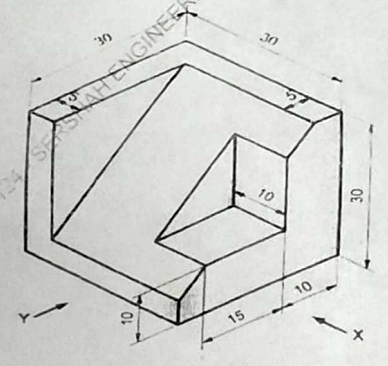
Isometric view of an object is given. Draw the front view looking in the direction X, right-side view looking in the direction Y and top view of the object by first angle projection method.
Q.9 Solve this question:
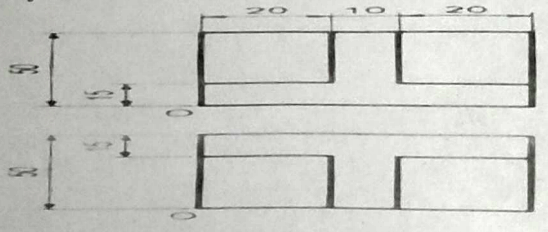
The following figure shows two orthographic views of an object [refer to paper image]. Draw the isometric projection of the object.
Instructions:
- The marks are indicated in the right-hand margin.
- There are NINE questions in this paper.
- Attempt FIVE questions in all.
- Question No. 1 is compulsory.
Q.1 Choose the correct answer of the following (Any seven questions
only):
When the drawing are drawn smaller than the actual size of object then the scale is known as
When the plane cuts the cone parallel to one of the generator the curve traced out by the section is
When the front view of line having length less than the original length then which of the following is correct
If a point is situated behind the V.P. it's top view will be
If a circle whose surface is inclined to H.P. and perpendicular to V.P., Its Top view will be
In orthographic projection, visual rays or line of sight for a given view are to each other.
Which of the following solids is a polyhedron
The angle between isometric axes is.......
Which method of development is employed in case of pyramid?
Which command is used to bevel the edges of objects?
Q.2 Solve both questions:
On map of Patna City 1cm represents 1km. Construct a scale to measure the distance between Bihar Engineering University and Patna University is 6 km. Also indicate on scale, the distance between Patna railway station and Rajendranagar Terminal which is 3 km and 7 hectometers.
Construct the involute of a pentagonal of sides 25 mm. Draw the tangent and normal to the involute at a point 100 mm from the center of the pentagonal.
Q.3 Solve this question:
A wheel of motorcycle 60 mm in diameters roll on a straight horizontal road. Draw the locus of a point 'P' on the periphery of the wheel for one revolution of the wheel. Initially point P is farthest from road.
Q.4 Solve this question:
The front view of 85 mm long straight line AB measure 60 mm while its top view measure 70 mm. Draw the projection of AB if it's end A is 10 mm above HP and 20 mm behind VP, while it's end B is in first quadrant. Draw the projections of line and determine the inclination of line AB with the reference planes.
Q.5 Solve this question:
A semi-circular plate of 40 mm diameter has its straight edge in the V.P. and inclined at $ 45^{\circ} $ to the H.P. The surface of the plate makes an angle $ 30^{\circ} $ with the V.P draw its projections.
Q.6 Solve this question:
A pentagonal pyramid side of base 35 mm and axis length 70 mm kept on the VP on one of its base edges in such a way that the triangular face containing that base edge is perpendicular to V.P. and parallel to H.P. Draw the projections of the pyramid.
Q.7 Solve this question:
A square prism side of base 45 mm and axis length 90 mm has its axis vertical and rectangular faces equally inclined to V.P. A Square hole of sides 30 mm in drilled through the prism completely such that axis of hole is perpendicular to V.P. and bisects the axis of vertical square prism. The sides of a square hole are equally inclined to H.P. Draw the development of lateral surface with effect of hole.
Q.8 Solve this question:
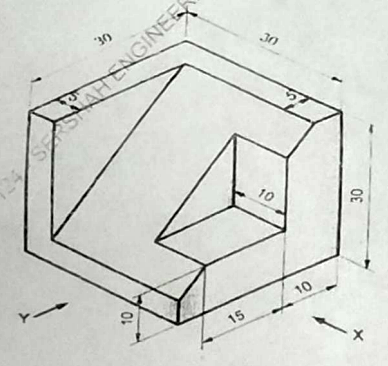
Isometric view of an object is given. Draw the front view looking in the direction X, right-side view looking in the direction Y and top view of the object by first angle projection method.
Q.9 Solve this question:
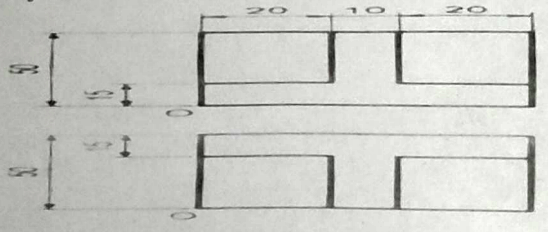
The following figure shows two orthographic views of an object [refer to paper image]. Draw the isometric projection of the object.
Instructions:
- The marks are indicated in the right-hand margin.
- There are NINE questions in this paper.
- Attempt FIVE questions in all.
- Question No. 1 is compulsory.
- Use the First Angle of Projection Method.
- All dimensions are in mm.
Q.1 Choose the correct answer of the following (Any seven question
only):
What is the most important part of a print?
Which set of lead grades has a grade out of sequence?
An area of 36 square kilometer is represented by 144 square centimeters on a map. What is the R.F.?
A cube is resting on the H.P. with a solid diagonal perpendicular to it. The top view will appear as
The trace of a hexagonal plane may be
In inclined lettering, the stem is inclined to the left at
The line joining the front and top views of a point is called
The recommended symbol for indicating the angle of projection shows two views of the frustum of a
Which coordinate system is stationary and cannot be translated or rotated
How many points do you need to define for the rectangle command?
Q.2 Solve both questions :
Write the following sentence using free hand Vertical Capital letters in lettering B (h=7) usually using single stroke.
"GOOD LETTERING GIVES BETTER APPEARANCE"
Using the provided AutoCAD commands below, create the final drawing on your sheet.
Enter LINE command: L [Enter] → Start line at point A: 0,0 [Enter] → End first line at point B: @2.828<45 [Enter]→ End of second line at point C: @1<90 [Enter]
Q.3 Solve this question :
Construct a hypocycloid, rolling circle 50 mm diameter and directing circle 175 mm diameter. Draw a tangent and a normal to it at a point 50 mm from the centre of the directing circle.
Q.4 Solve both questions :
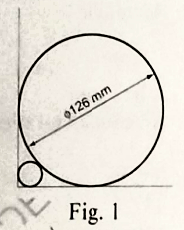
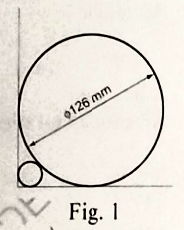
Figure 1 shows two touching circles placed in the corner made by two lines which are perpendicular to one another. Draw the view shown and state the diameter of the smaller circle. Your construction must show clearly the method of obtaining the centre of the smaller circle.
Construct a regular heptagon within a circle, radius 60 mm. The corners of the heptagon must lie on the circumference of the circle.
Q.5 Solve this question :
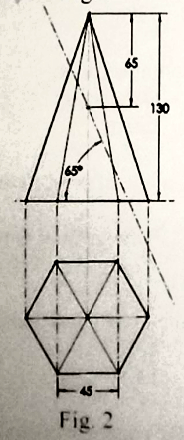
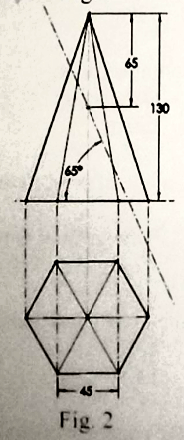
Draw the development of the lateral surface for the hexagonal pyramid as shown in Fig. 2.
Q.6 Solve this question :
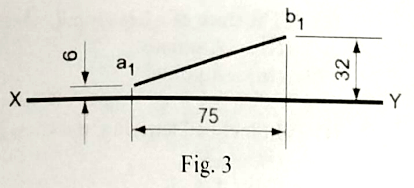
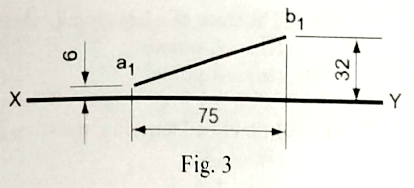
Figure 3 shows the projected elevation of a line AB which has a true length of 100 mm. End B of the line is 12 mm in front of the VP; end A is also in front of the VP. Draw the plan a, b and elevation of this line and determine and indicate its VT and HT. Measure, state and indicate the angle of inclination of the line to the HP.
Q.7 Solve this question :
A hollow square prism, base 50 mm side (outside), length 75 mm and thickness 9 mm is lying on the H.P. on one of its rectangular faces, with the axis inclined at 30° to the V.P. A section plane, parallel to the V.P. cuts the prism, intersecting the axis at a point 25 mm from one of its ends. Draw the top view and sectional front view of the prism.
Q.8 Solve this question :
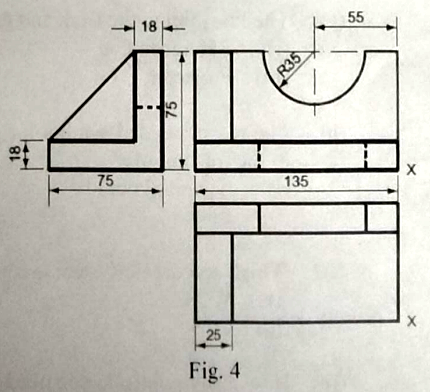
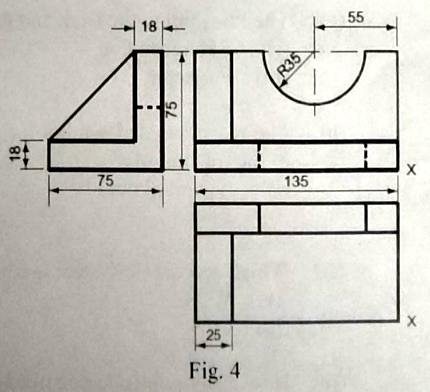
Construct an isometric scale and use it to make a true isometric view of the casting shown in Fig. 4. Corner X is to be the lowest corner of your drawing.
Q.9 Solve this question :
Construct a diagonal scale of $ R.F. = 1/4000 $ to show meters and long enough to measure up to 500 meters. Show the length of 394 metres on it.
Instructions:
- The marks are indicated in the right-hand margin.
- There are NINE questions in this paper.
- Attempt FIVE questions in all.
- Question No. 1 is compulsory.
- Use the First Angle of Projection Method.
- All dimensions are in mm.
Q.1 Choose the correct answer of the following (Any seven question
only):
What is the most important part of a print?
Which set of lead grades has a grade out of sequence?
An area of 36 square kilometer is represented by 144 square centimeters on a map. What is the R.F.?
A cube is resting on the H.P. with a solid diagonal perpendicular to it. The top view will appear as
The trace of a hexagonal plane may be
In inclined lettering, the stem is inclined to the left at
The line joining the front and top views of a point is called
The recommended symbol for indicating the angle of projection shows two views of the frustum of a
Which coordinate system is stationary and cannot be translated or rotated
How many points do you need to define for the rectangle command?
Q.2 Solve both questions :
Write the following sentence using free hand Vertical Capital letters in lettering B (h=7) usually using single stroke.
Using the provided AutoCAD commands below, create the final drawing on your sheet.
Q.3 Solve this question :
Construct a hypocycloid, rolling circle 50 mm diameter and directing circle 175 mm diameter. Draw a tangent and a normal to it at a point 50 mm from the centre of the directing circle.
Q.4 Solve both questions :
Figure 1 shows two touching circles placed in the corner made by two lines which are perpendicular to one another. Draw the view shown and state the diameter of the smaller circle. Your construction must show clearly the method of obtaining the centre of the smaller circle.
Construct a regular heptagon within a circle, radius 60 mm. The corners of the heptagon must lie on the circumference of the circle.
Q.5 Solve this question :
Draw the development of the lateral surface for the hexagonal pyramid as shown in Fig. 2.
Q.6 Solve this question :
Figure 3 shows the projected elevation of a line AB which has a true length of 100 mm. End B of the line is 12 mm in front of the VP; end A is also in front of the VP. Draw the plan a, b and elevation of this line and determine and indicate its VT and HT. Measure, state and indicate the angle of inclination of the line to the HP.
Q.7 Solve this question :
A hollow square prism, base 50 mm side (outside), length 75 mm and thickness 9 mm is lying on the H.P. on one of its rectangular faces, with the axis inclined at 30° to the V.P. A section plane, parallel to the V.P. cuts the prism, intersecting the axis at a point 25 mm from one of its ends. Draw the top view and sectional front view of the prism.
Q.8 Solve this question :
Construct an isometric scale and use it to make a true isometric view of the casting shown in Fig. 4. Corner X is to be the lowest corner of your drawing.
Q.9 Solve this question :
Construct a diagonal scale of to show meters and long enough to measure up to 500 meters. Show the length of 394 metres on it.
Instructions:
- The marks are indicated in the right-hand margin.
- There are NINE questions in this paper.
- Attempt FIVE questions in all.
- Question No. 1 is compulsory.
- Use the First Angle of Projection Method.
- All dimensions are in mm.
Q.1 Choose the correct answer of the following (Any seven question
only):
What is the most important part of a print?
Which set of lead grades has a grade out of sequence?
An area of 36 square kilometer is represented by 144 square centimeters on a map. What is the R.F.?
A cube is resting on the H.P. with a solid diagonal perpendicular to it. The top view will appear as
The trace of a hexagonal plane may be
In inclined lettering, the stem is inclined to the left at
The line joining the front and top views of a point is called
The recommended symbol for indicating the angle of projection shows two views of the frustum of a
Which coordinate system is stationary and cannot be translated or rotated
How many points do you need to define for the rectangle command?
Q.2 Solve both questions :
Write the following sentence using free hand Vertical Capital letters in lettering B (h=7) usually using single stroke.
Using the provided AutoCAD commands below, create the final drawing on your sheet.
Q.3 Solve this question :
Construct a hypocycloid, rolling circle 50 mm diameter and directing circle 175 mm diameter. Draw a tangent and a normal to it at a point 50 mm from the centre of the directing circle.
Q.4 Solve both questions :
Figure 1 shows two touching circles placed in the corner made by two lines which are perpendicular to one another. Draw the view shown and state the diameter of the smaller circle. Your construction must show clearly the method of obtaining the centre of the smaller circle.
Construct a regular heptagon within a circle, radius 60 mm. The corners of the heptagon must lie on the circumference of the circle.
Q.5 Solve this question :
Draw the development of the lateral surface for the hexagonal pyramid as shown in Fig. 2.
Q.6 Solve this question :
Figure 3 shows the projected elevation of a line AB which has a true length of 100 mm. End B of the line is 12 mm in front of the VP; end A is also in front of the VP. Draw the plan a, b and elevation of this line and determine and indicate its VT and HT. Measure, state and indicate the angle of inclination of the line to the HP.
Q.7 Solve this question :
A hollow square prism, base 50 mm side (outside), length 75 mm and thickness 9 mm is lying on the H.P. on one of its rectangular faces, with the axis inclined at 30° to the V.P. A section plane, parallel to the V.P. cuts the prism, intersecting the axis at a point 25 mm from one of its ends. Draw the top view and sectional front view of the prism.
Q.8 Solve this question :
Construct an isometric scale and use it to make a true isometric view of the casting shown in Fig. 4. Corner X is to be the lowest corner of your drawing.
Q.9 Solve this question :
Construct a diagonal scale of to show meters and long enough to measure up to 500 meters. Show the length of 394 metres on it.
Instructions:
- The marks are indicated in the right-hand margin.
- There are NINE questions in this paper.
- Attempt FIVE questions in all.
- Question No. 1 is compulsory.
- Use the First Angle of Projection Method.
- All dimensions are in mm.
Q.1 Choose the correct answer of the following (Any seven question
only):
What is the most important part of a print?
Which set of lead grades has a grade out of sequence?
An area of 36 square kilometer is represented by 144 square centimeters on a map. What is the R.F.?
A cube is resting on the H.P. with a solid diagonal perpendicular to it. The top view will appear as
The trace of a hexagonal plane may be
In inclined lettering, the stem is inclined to the left at
The line joining the front and top views of a point is called
The recommended symbol for indicating the angle of projection shows two views of the frustum of a
Which coordinate system is stationary and cannot be translated or rotated
How many points do you need to define for the rectangle command?
Q.2 Solve both questions :
Write the following sentence using free hand Vertical Capital letters in lettering B (h=7) usually using single stroke.
Using the provided AutoCAD commands below, create the final drawing on your sheet.
Q.3 Solve this question :
Construct a hypocycloid, rolling circle 50 mm diameter and directing circle 175 mm diameter. Draw a tangent and a normal to it at a point 50 mm from the centre of the directing circle.
Q.4 Solve both questions :
Figure 1 shows two touching circles placed in the corner made by two lines which are perpendicular to one another. Draw the view shown and state the diameter of the smaller circle. Your construction must show clearly the method of obtaining the centre of the smaller circle.
Construct a regular heptagon within a circle, radius 60 mm. The corners of the heptagon must lie on the circumference of the circle.
Q.5 Solve this question :
Draw the development of the lateral surface for the hexagonal pyramid as shown in Fig. 2.
Q.6 Solve this question :
Figure 3 shows the projected elevation of a line AB which has a true length of 100 mm. End B of the line is 12 mm in front of the VP; end A is also in front of the VP. Draw the plan a, b and elevation of this line and determine and indicate its VT and HT. Measure, state and indicate the angle of inclination of the line to the HP.
Q.7 Solve this question :
A hollow square prism, base 50 mm side (outside), length 75 mm and thickness 9 mm is lying on the H.P. on one of its rectangular faces, with the axis inclined at 30° to the V.P. A section plane, parallel to the V.P. cuts the prism, intersecting the axis at a point 25 mm from one of its ends. Draw the top view and sectional front view of the prism.
Q.8 Solve this question :
Construct an isometric scale and use it to make a true isometric view of the casting shown in Fig. 4. Corner X is to be the lowest corner of your drawing.
Q.9 Solve this question :
Construct a diagonal scale of to show meters and long enough to measure up to 500 meters. Show the length of 394 metres on it.
Instructions:
- The marks are indicated in the right-hand margin.
- There are NINE questions in this paper.
- Attempt FIVE questions in all.
- Question No. 1 is compulsory.
- Use the First Angle of Projection Method.
- All dimensions are in mm.
Q.1 Choose the correct answer of the following (Any seven question
only):
What is the most important part of a print?
Which set of lead grades has a grade out of sequence?
An area of 36 square kilometer is represented by 144 square centimeters on a map. What is the R.F.?
A cube is resting on the H.P. with a solid diagonal perpendicular to it. The top view will appear as
The trace of a hexagonal plane may be
In inclined lettering, the stem is inclined to the left at
The line joining the front and top views of a point is called
The recommended symbol for indicating the angle of projection shows two views of the frustum of a
Which coordinate system is stationary and cannot be translated or rotated
How many points do you need to define for the rectangle command?
Q.2 Solve both questions :
Write the following sentence using free hand Vertical Capital letters in lettering B (h=7) usually using single stroke.
"GOOD LETTERING GIVES BETTER APPEARANCE"
Using the provided AutoCAD commands below, create the final drawing on your sheet.
Enter LINE command: L [Enter] → Start line at point A: 0,0 [Enter] → End first line at point B: @2.828<45 [Enter]→ End of second line at point C: @1<90 [Enter]
Q.3 Solve this question :
Construct a hypocycloid, rolling circle 50 mm diameter and directing circle 175 mm diameter. Draw a tangent and a normal to it at a point 50 mm from the centre of the directing circle.
Q.4 Solve both questions :
Figure 1 shows two touching circles placed in the corner made by two lines which are perpendicular to one another. Draw the view shown and state the diameter of the smaller circle. Your construction must show clearly the method of obtaining the centre of the smaller circle.
Construct a regular heptagon within a circle, radius 60 mm. The corners of the heptagon must lie on the circumference of the circle.
Q.5 Solve this question :
Draw the development of the lateral surface for the hexagonal pyramid as shown in Fig. 2.
Q.6 Solve this question :
Figure 3 shows the projected elevation of a line AB which has a true length of 100 mm. End B of the line is 12 mm in front of the VP; end A is also in front of the VP. Draw the plan a, b and elevation of this line and determine and indicate its VT and HT. Measure, state and indicate the angle of inclination of the line to the HP.
Q.7 Solve this question :
A hollow square prism, base 50 mm side (outside), length 75 mm and thickness 9 mm is lying on the H.P. on one of its rectangular faces, with the axis inclined at 30° to the V.P. A section plane, parallel to the V.P. cuts the prism, intersecting the axis at a point 25 mm from one of its ends. Draw the top view and sectional front view of the prism.
Q.8 Solve this question :
Construct an isometric scale and use it to make a true isometric view of the casting shown in Fig. 4. Corner X is to be the lowest corner of your drawing.
Q.9 Solve this question :
Construct a diagonal scale of $ R.F. = 1/4000 $ to show meters and long enough to measure up to 500 meters. Show the length of 394 metres on it.
Instructions:
- The marks are indicated in the right-hand margin.
- There are NINE questions in this paper.
- Attempt FIVE questions in all.
- Question No. 1 is compulsory.
Q.1 Choose the correct answer of the following (any seven):
The size 210 mm × 297 mm of drawing sheet recommended by the bureau of Indian Standard is for:
The actual length of the drawing is 200m; the RF is given as 1:2500. Find length of the drawing.
In a scale, a line of length 2 cm is drawn on the drawing sheet to represent an actual length of 1 m. The representative fraction (RF) value is
In first angle projection method
When are the projectors parallel to each other and perpendicular to the plane of projection?
If a line AB is inclined at 45° to the HP and parallel to the VP, its true length is shown in
The FV and TV of a line represent true lengths, if the line is
TV view of a square plane parallel to HP and perpendicular to VP is a
Which of the following is DRAW command?
If the distance from the focus is 8 mm and the distance from the directrix is 2 mm then what is the name of the conic section?
Q.2 Solve both questions :
A point 'A' is situated in the first quadrant. Its shortest distance from the intersection point of HP, VP and auxiliary plane is 60 mm and it is equidistant from principal planes. Draw the projections of the point and determine its distance from the principal planes.
Draw an ellipse by using 'arc of circle' method, given its major and minor axes as 100mm and 70mm respectively. Also draw a tangent and a normal to the ellipse.
Q.3 Solve this question :
The front view of straight-line AB is 60mm long and is inclined at $60^\circ$ to the reference line XY. The end point A is 15mm above H.P. and 20mm infront of V.P. Draw the projections of a line AB if it is inclined at $45^\circ$ to the V.P. and is situated in the first quadrant. Determine its true length, and inclination with the H.P.
Q.4 Solve this question :
Draw the projections of a regular hexagon of 25 mm side, having one of its sides in the HP and inclined at $60^\circ$ to the VP, and its surface making an angle of $45^\circ$ with the HP.
Q.5 Solve this question :
A circular plate of negligible thickness and 50mm diameter appears as an ellipse in the front view, having its major axis 50mm long and minor axis 30mm long. Draw its top view when the major axis of the ellipse is horizontal.
Q.6 Solve this question :
A cone, base 75mm diameter and axis 80mm long is resting on its base on the H.P. It is cut by a section plane perpendicular to the V.P., inclined at $45^\circ$ to the H.P. and cutting the axis at a point 35mm from the apex. Draw its front view, sectional top view and true shape of the section.
Q.7 Solve this question :
A cylinder of diameter 60mm and height 60mm is resting vertically on one of its ends on the H.P. It is cut by a plane perpendicular to the V.P. and inclined at $30^\circ$ to the H.P. The plane meets the axis at a point 30mm from the base. Draw the development of the lateral surface of the lower portion of the cylinder.
Q.8 Solve this question :
Isometric view an object is given below. Draw three views of this object by first angle projection method.
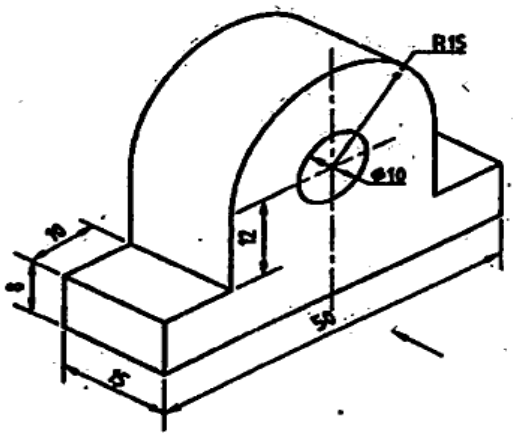
Q.9 Solve this question :
Draw the isometric drawing of the frustum of a right regular hexagonal pyramid, side of base hexagon 20mm, side of top hexagon is 10mm and height of the frustum is 40mm.
Instructions:
- The marks are indicated in the right-hand margin.
- There are NINE questions in this paper.
- Attempt FIVE questions in all.
- Question No. 1 is compulsory.
Q.1 Choose the correct answer of the following (any seven):
The size 210 mm × 297 mm of drawing sheet recommended by the bureau of Indian Standard is for:
The actual length of the drawing is 200m; the RF is given as 1:2500. Find length of the drawing.
In a scale, a line of length 2 cm is drawn on the drawing sheet to represent an actual length of 1 m. The representative fraction (RF) value is
In first angle projection method
When are the projectors parallel to each other and perpendicular to the plane of projection?
If a line AB is inclined at 45° to the HP and parallel to the VP, its true length is shown in
The FV and TV of a line represent true lengths, if the line is
TV view of a square plane parallel to HP and perpendicular to VP is a
Which of the following is DRAW command?
If the distance from the focus is 8 mm and the distance from the directrix is 2 mm then what is the name of the conic section?
Q.2 Solve both questions :
A point 'A' is situated in the first quadrant. Its shortest distance from the intersection point of HP, VP and auxiliary plane is 60 mm and it is equidistant from principal planes. Draw the projections of the point and determine its distance from the principal planes.
Draw an ellipse by using 'arc of circle' method, given its major and minor axes as 100mm and 70mm respectively. Also draw a tangent and a normal to the ellipse.
Q.3 Solve this question :
The front view of straight-line AB is 60mm long and is inclined at $60^\circ$ to the reference line XY. The end point A is 15mm above H.P. and 20mm infront of V.P. Draw the projections of a line AB if it is inclined at $45^\circ$ to the V.P. and is situated in the first quadrant. Determine its true length, and inclination with the H.P.
Q.4 Solve this question :
Draw the projections of a regular hexagon of 25 mm side, having one of its sides in the HP and inclined at $60^\circ$ to the VP, and its surface making an angle of $45^\circ$ with the HP.
Q.5 Solve this question :
A circular plate of negligible thickness and 50mm diameter appears as an ellipse in the front view, having its major axis 50mm long and minor axis 30mm long. Draw its top view when the major axis of the ellipse is horizontal.
Q.6 Solve this question :
A cone, base 75mm diameter and axis 80mm long is resting on its base on the H.P. It is cut by a section plane perpendicular to the V.P., inclined at $45^\circ$ to the H.P. and cutting the axis at a point 35mm from the apex. Draw its front view, sectional top view and true shape of the section.
Q.7 Solve this question :
A cylinder of diameter 60mm and height 60mm is resting vertically on one of its ends on the H.P. It is cut by a plane perpendicular to the V.P. and inclined at $30^\circ$ to the H.P. The plane meets the axis at a point 30mm from the base. Draw the development of the lateral surface of the lower portion of the cylinder.
Q.8 Solve this question :
Isometric view an object is given below. Draw three views of this object by first angle projection method.
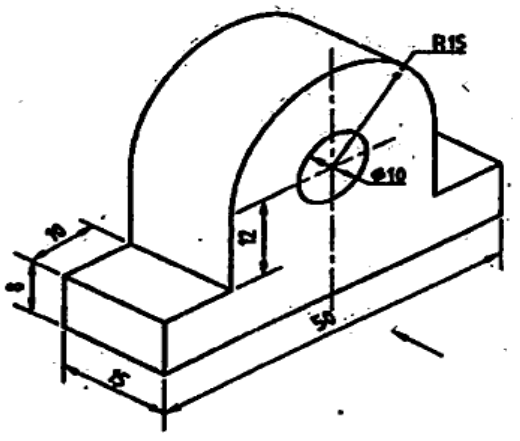
Q.9 Solve this question :
Draw the isometric drawing of the frustum of a right regular hexagonal pyramid, side of base hexagon 20mm, side of top hexagon is 10mm and height of the frustum is 40mm.
Instructions:
- The marks are indicated in the right-hand margin.
- There are NINE questions in this paper.
- Attempt FIVE questions in all.
- Question No. 1 is compulsory.
- Choose the correct answer of the following (any seven):
French curves are used for drawing
Long-dashed dotted narrow lines are used to show
Which one is the reducing scale?
When a line is inclined to both the planes, HP and VP, the true length of the line is seen in
The eccentricity of an ellipse is
Section plane can be
Isometric projection
The major functions to be performed by a computer-aided drafting system are
Which function toggles between ORTHO modes?
TTT command is used for drawing
Questions (Attempt any four from the rest):
A line AB is in the first quadrant. Its ends A and B are 20 mm and 60 mm in front of the VP respectively. The distance between the end projectors is 75 mm. The line is inclined at 30° to the HP and its horizontal trace is 10 mm above XY. Draw the projections of AB and determine its true length.
Draw the projections of a pentagonal pyramid, base 30 mm edge and axis 50 mm long, having its base on the HP and an edge of the base parallel to the VP.
Draw the projections of a cone, base 50 mm diameter and axis 75 mm long, lying on a generator on the ground with the top view of the axis making an angle of 45° with the VP.
A square prism, base 40 mm side, axis 80 mm long, has its base on the HP and its faces equally inclined to the VP. It is cut by a plane, perpendicular to the VP, inclined at 60° to the HP and passing through a point on the axis, 55 mm above the HP. Draw its front view, sectional top view and another top view on an AIP parallel to the section plane.
Projection of the frustum of the cone is shown in figure below. Draw its isometric view.